Main Points
- Write the business case and name a sponsor before you choose any tool or provider.
- Build the foundation, with access, network, budgets and rules, before the first workload moves.
- Run one pilot, then migrate in waves ranked by payoff and risk.
- Expect a first live workload in four to five months and a full rollout in 12 to 24.
A cloud adoption roadmap should tell your leadership what happens next, who owns it and when to stop and check. Most roadmaps I am shown list providers and migration dates. The useful ones list decisions, owners and gates.
The plan below has six phases. When I do cloud adoption consulting, I give clients this skeleton and fit it to their size. The timing comes from my own projects and assumes a company with 20 to 200 applications. The same ideas appear in the AWS, Microsoft and Google adoption frameworks, which I list in the sources.
The Roadmap on One Page
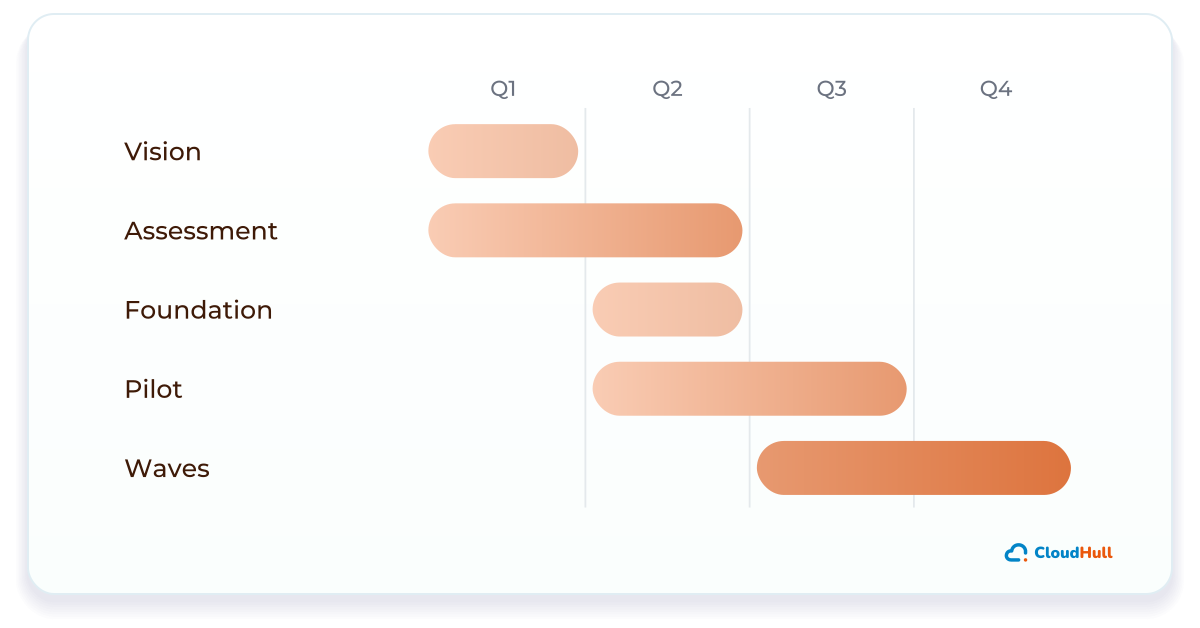
| Phase | When | Goal | Output |
|---|---|---|---|
| Phase 1: Vision and Business Case | Weeks 1 to 4 | Agree why you are moving and what success means. | A one-page case, targets and a sponsor |
| Phase 2: Assessment and Skills Plan | Weeks 3 to 8 | Find out what is ready, what is not and who needs training. | A scored application list and a skills plan |
| Phase 3: Foundation and Guardrails | Weeks 6 to 16 | Build the accounts, access, network and rules every team will use. | A landing zone, budgets and policies in code |
| Phase 4: Pilot Workload | Months 3 to 5 | Move one real workload end to end and learn from it. | A live workload and a list of lessons |
| Phase 5: Migration Waves | Months 5 to 14 | Move groups of applications ranked by payoff and risk. | Workloads live, old environments retired |
| Phase 6: Operate and Optimize | Month 12 onward | Run the cloud as a product and keep improving cost and reliability. | Quarterly reviews and a team that owns it |
Phase 1: Vision and Business Case
Spend the first month on why. Write down the one or two outcomes that matter, such as shipping features faster, closing a data center or entering a new region. Attach numbers to them, such as release frequency, hardware renewal cost or time to provision an environment.
Name a sponsor with authority over budget and people, and add contacts from finance, security and engineering. The common failure here is a roadmap owned by infrastructure alone, because the first conflict with a product team or a budget holder stalls it. Frameworks from Microsoft and AWS both start with strategy and business perspectives for this reason.
Gate to move on: a written case with targets, a sponsor and a rough budget range.
Phase 2: Assessment and Skills Plan
Now find out what you have. List applications, their owners, dependencies, data sensitivity, licensing and how often they change. Score each one for readiness and payoff. My guide to a cloud adoption assessment lays out the scoring I use, and it works for 20 applications or 2,000.
Assess people at the same time. Count who holds cloud certifications, who has run production workloads and who will need training. Hiring takes months, so start the skills plan early. A mix of training for existing engineers and two or three experienced hires or partners is typical.
Gate to move on: a scored application list, a decision for each application (move, retire, keep) and a skills plan with dates.
Phase 3: Foundation and Guardrails
This phase is the one most teams want to skip, and the one that saves the most later. Build a landing zone: an account or subscription structure, identity and access, a network with a planned address range, logging, encryption defaults and budgets. Define it in code, so a new environment is a pull request.
Guardrails belong here too. Decide the allowed regions, required tags, approved services and who may create what. Cloud networks and identity are hard to rearrange once twenty teams depend on them, so give this phase real time. For the network side, the cloud networking consulting page explains what a sound address plan and topology include.
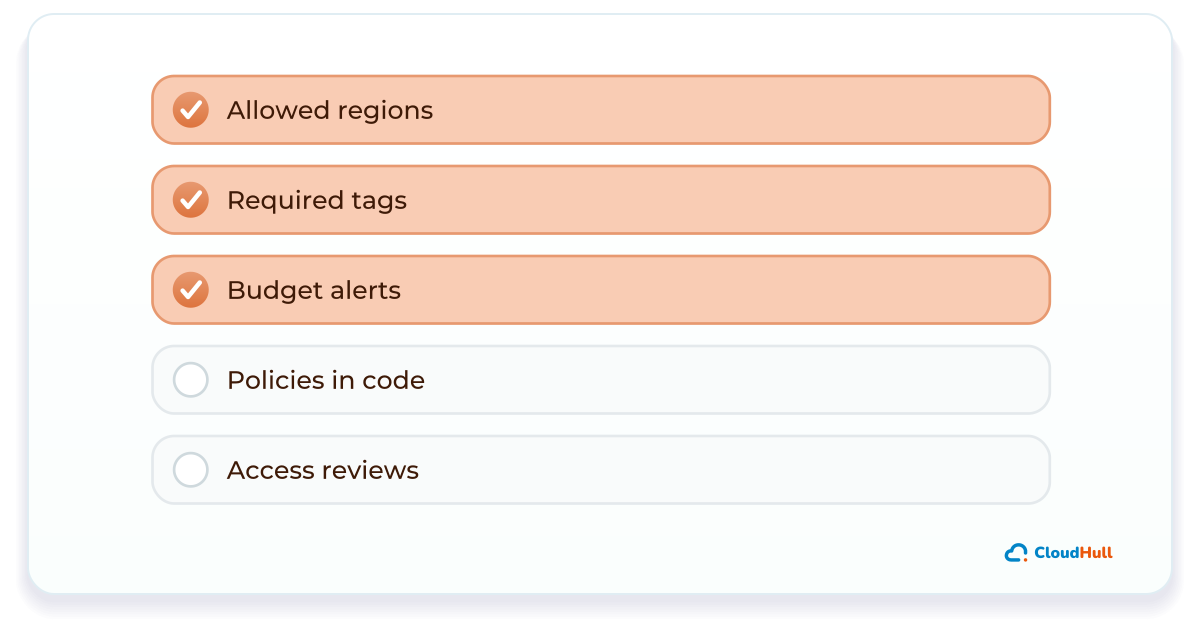
Gate to move on: a team that was not involved in the build creates a working environment from the templates in under a day.
Phase 4: Pilot Workload
Pick a workload with real users, moderate risk and a team that wants to change. Take it through the full path: replatform or rehost as the assessment decided, pipeline, monitoring, security review, cutover and rollback plan. Keep the pilot team small, with the engineers who will later teach others.
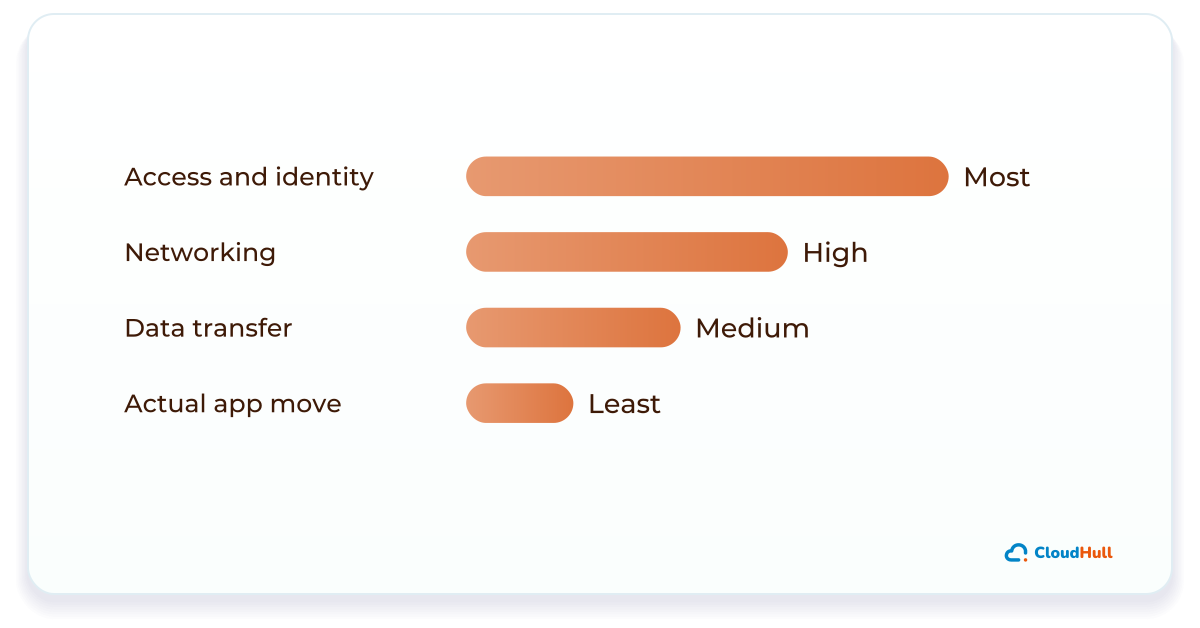
In my client work, the first month of a pilot goes mostly into access requests, firewall changes and security sign-off, not into the migration itself. Plan for that. Shift production traffic in stages, perhaps 5%, 25% and then all of it, and keep the old path as a fallback for a few weeks.
Gate to move on: the pilot serves all its traffic, cost per environment is visible, and the team has written a short list of what to change in the foundation.
Phase 5: Migration Waves
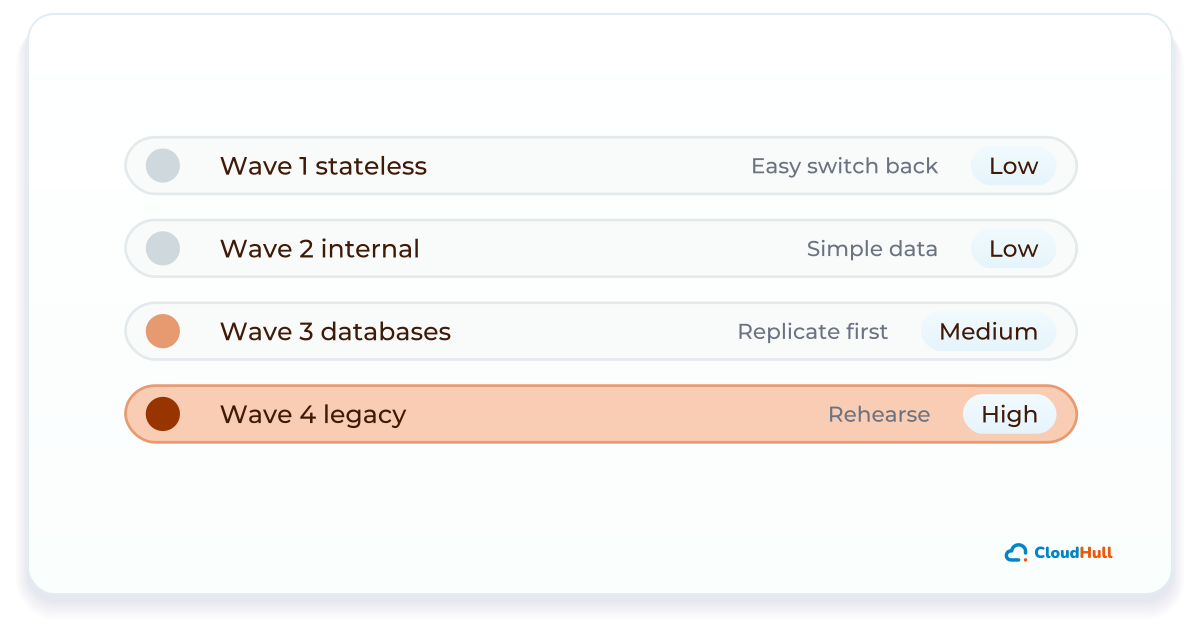
Group applications into waves of three to eight, using the scores from phase 2, and keep each wave to a quarter. Every wave ends with a short review. Retire what you can, move what can stay as it is and change code only where the payoff is clear.
| Wave | Typical contents | Risk | Rollback plan |
|---|---|---|---|
| Wave 1 | Websites, dev and test environments, stateless services | Low | Point traffic back to the old environment |
| Wave 2 | Internal tools and applications with simple data | Low to medium | Keep the source running until checks pass |
| Wave 3 | Databases and applications with shared state | Medium | Replication in place and a tested switch-back |
| Wave 4 | Business-critical and legacy systems | High | Full rehearsal and a defined cutover window |
Migration tooling matters less than sequencing. Common mistakes are covered in my list of cloud adoption challenges, and most of them are about dependencies and people, not about copying data.
Gate to move on: planned applications run in the cloud, old environments are switched off and actual cost is within 15% of plan.
Phase 6: Operate and Optimize
From about month twelve, the work changes from moving to running well. Review spend by team every month, rightsize resources, use commitment discounts for steady workloads and shut down idle environments. Flexera's 2026 State of the Cloud report estimates wasted cloud spend at 29%, so there is nearly always something to find.
Turn the program team into a standing platform group, and keep a cloud center of excellence that maintains standards. The habits I check on mature programs are in my guide to cloud adoption best practices.
Gate to finish: a quarterly review shows progress on the goals from phase 1, and your team can run the platform without outside help.
Who You Need in Each Phase
Roadmaps fail quietly when the people side is vague. The table lists the roles I plan for. Many are part-time, and one person can hold more than one role in a small company.
| Phase | Core roles | Time commitment |
|---|---|---|
| Phases 1 and 2 | Sponsor, program lead, architect, finance and security contacts | About one day a week each |
| Phase 3 | Platform engineers, a security engineer, a network engineer | Mostly full time |
| Phase 4 | Pilot team plus platform engineers | Mostly full time |
| Phase 5 | Platform team plus application teams, wave by wave | A few weeks per team per wave |
| Phase 6 | Platform team, finance and reliability owners | Steady, ongoing |
The most common gap is a platform team that exists on paper. If the engineers who built the pilot return to feature work in phase 5, every application team solves the same problems again. Protect that time in the plan, and tell the business what it will not get from those engineers for a while.
Budget follows the same logic. In my client work, people cost is the largest line in the first year, usually bigger than cloud spend. Add a reserve of around 15% for surprises such as an undocumented dependency or a license that does not transfer.
Where Roadmaps Slip, and How to Respond
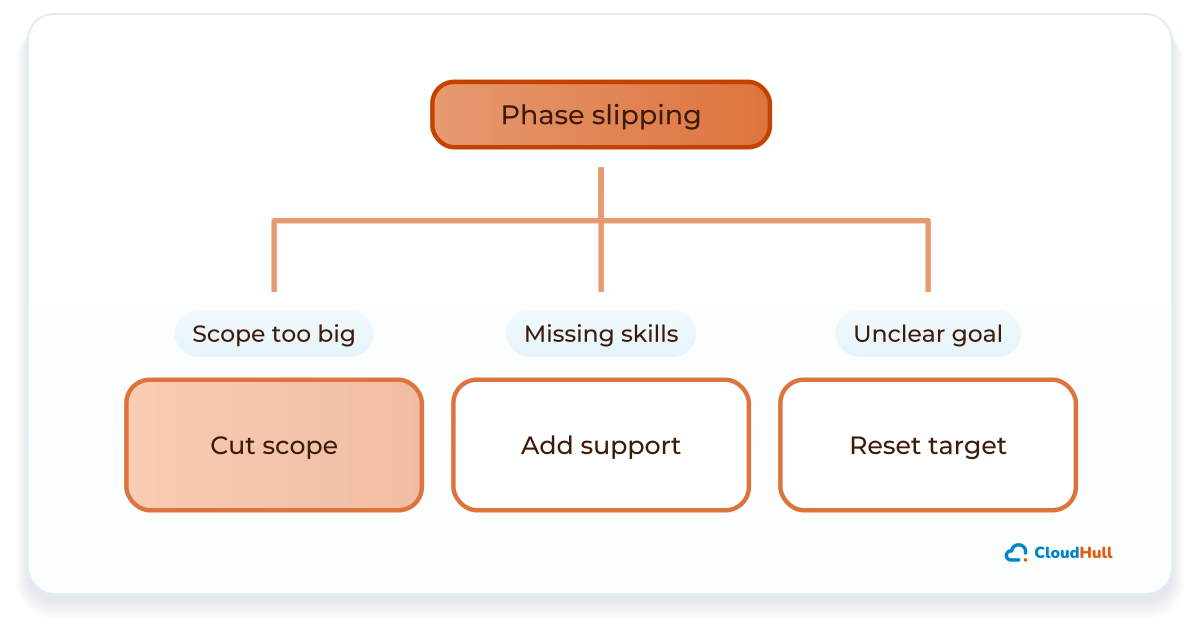
In my experience, plans slip in four places. Access approvals and security reviews take weeks, so start them on day one. A pilot chosen for its importance stalls on every risk discussion. The platform team is staffed part-time and gets pulled into incidents. Scope grows, and each phase collects extra goals until it no longer fits its time box.
The response is the same in each case: cut scope, not quality, and move dates only after cutting. The risks that threaten the program itself are covered in my article on cloud adoption risks.
One habit helps all six phases: a short written note at the end of each. Record what you planned, what happened, what you changed and what you would do differently. Those notes train the next wave and give leadership an honest view when the schedule moves.
How to Adapt the Roadmap to Your Company
Use the phases as a skeleton and adjust the length to your size. A 30-person company can compress phases 1 to 3 into a quarter. A regulated company may need extra weeks for security and audit review in phase 3. Before you commit, check four things:
- Every phase has a gate with measurable checks.
- Someone owns each phase and has time set aside for it.
- The budget covers people and training, not only cloud bills and licenses.
- Leadership knows that the first quarter delivers a foundation, not a finished migration.
If you want a second pair of eyes, a short assessment can turn this skeleton into a dated plan for your applications.
Questions About Your Cloud Adoption Roadmap
How Long Does a Cloud Adoption Roadmap Take to Execute?
A first live workload usually arrives in four to five months. Moving a full portfolio takes 12 to 24 months for many mid-sized companies, and longer if you have many legacy systems or strict compliance reviews.
Who Should Own the Roadmap?
One named sponsor with authority over budget and engineering time. Many programs assign this to a cloud program lead who reports to the CIO or CTO, with finance and security contacts attached.
Do I Need a Cloud Center of Excellence?
A small group that owns standards, the landing zone and training helps from the pilot onward. It can start with three or four people from engineering, security and finance, and it does not have to be a formal department.
Should I Pick a Single Cloud Provider?
Pick a primary one for the first waves. Multi-cloud adds skills, tooling and transfer costs, so add a second provider only for a clear reason such as a specific service, a customer demand or a regulatory need.
What If the Pilot Goes Badly?
Treat it as information. Find out whether the cause was the application, the foundation or the team's skills, adjust and run a second pilot. Small failures early are the point of a pilot.
Do I Have to Move Every Application?
No. Some applications are better retired, replaced or left in place. A good roadmap lists them as decisions with a reason, so nobody feels the program is unfinished.
How Do I Keep the Roadmap from Slipping?
Keep each phase short, set a gate with measurable checks and cut scope instead of moving dates. Phases that mix too many goals are the ones that slip.
Sources
- AWS Cloud Adoption Framework
- Microsoft Cloud Adoption Framework for Azure
- Google Cloud Adoption Framework
- Flexera 2026 State of the Cloud Report
Please note: this guide is general information and not legal, financial or tax advice. Numbers and examples are typical-project estimates; confirm current details with your providers and advisers.
Did this article help you?
Thanks, noted.
Garrett Linville
Garrett leads the Cloud Hull editorial team and works with the consultants to turn real client projects into practical guides on cloud migration, DevOps, security and cost control. Each article is edited together with the consultant who did the work, and every price and limit is checked against current provider documentation. He is based in the USA and works remotely.