Deploys From Weekly to Daily
“Releases were a Friday event with three people on call. Cloud Hull built a CI/CD pipeline, added automated tests and set up infrastructure as code. We now deploy daily, and rollbacks take minutes instead of an evening.”
Strategy & Migration
Architecture & Infrastructure
DevOps & Cloud Native
Security & Cost Control
Data & Business Platforms
Your cloud network gets designed for speed, security and a predictable bill, across VPCs, VNets, on-premises links and every region you use. You start with a free first call and strategy workshop.

Cloud networking consulting is a service that helps your business design, connect, secure and run the network behind your cloud workloads: virtual networks, subnets, routing, firewalls, load balancers, DNS, private links and the connections to your offices and data centers. You start with the traffic your applications need, not with a product.
Cloud networks behave differently from the ones you know. Address space is shared between teams and accounts, routes are software, security rules attach to resources and traffic that crosses a region or leaves the cloud is billed. Small design choices, such as an overlapping address range, become expensive to change once many workloads depend on them.
In practice, cloud networking consulting covers an address plan, a hub-and-spoke or similar topology, hybrid connectivity, segmentation and firewall design, DNS and load balancing, observability, cost review of data transfer and training for the people who run it.
A good engagement covers the whole path from traffic map to a documented network your team can change safely.
Cloud networks grow quickly and quietly. Each team adds a VPC, a peering link or a firewall rule, and the picture nobody drew becomes the picture nobody understands.
Two networks that use the same range cannot be connected, so a merger or a new partner link means renumbering live systems.
Projects that wait for network rework
Traffic between regions, across zones and out to the internet is billed, and nobody knows which path costs what.
Charges that grow with every new workload
Traffic that takes a long route, a single VPN tunnel or a congested link makes applications feel slow for users.
Customers who wait or give up
Hundreds of firewall rules, added over years, mean open paths that nobody remembers allowing.
Wide access that attackers can use
Cloud networks that cause trouble were usually designed one project at a time. Yours starts with a map of how your applications, users and data actually communicate, and where that traffic crosses accounts, regions and your own sites.
From there you get a design that fits your size and compliance needs. The address plan leaves room for growth, shared services sit in one place, and the same segmentation pattern applies to every new workload.
A network is the part of the cloud every workload depends on, and the hardest to change later. A good design makes each new project faster, safer and cheaper. Start with the address plan and one connected pilot.
You talk through your applications, locations and the connectivity problems you have today. Your consultant asks about latency, compliance, outages and cloud bills, and tells you honestly what is worth changing.
Short and in writing, so you can share it with your team.
Address ranges, routes, firewall rules, links and traffic costs are reviewed. You see conflicts, single points of failure and wasteful paths.
Clear priorities, a target design and one fixed price for the first phase.
The target network is built in code and tested with one real workload. Connections to your sites, security rules and monitoring come with it, and your engineers work alongside the consultants.
Documented, monitored and running in your own cloud accounts.
Further workloads and sites move onto the new design in planned steps, while latency, availability and transfer cost are tracked against the starting point.
Performance and spend per path in one clear report.
Choose a single service or get the full program, from assessment to ongoing support.
A current diagram and an inventory of ranges, routes, links and rules.
Non-overlapping ranges for every account, region and site, with growth reserved.
Hub-and-spoke or a similar pattern, with shared services and clear routing.
Rules that allow only the traffic each workload needs, defined in code.
VPN and dedicated connections with failover to your offices and data centers.
Flow logs, alerts and a view of data transfer cost by path.


“Releases were a Friday event with three people on call. Cloud Hull built a CI/CD pipeline, added automated tests and set up infrastructure as code. We now deploy daily, and rollbacks take minutes instead of an evening.”
“A partner asked for proof of our cloud controls and we had none. Cloud Hull ran a security assessment, ranked 42 findings by risk and fixed the critical ones first. The partner review passed, and access is now reviewed every quarter.”
“On the discovery call they asked about our actual workloads instead of pitching a platform, and told us two systems should stay where they were. That honesty is why we hired them. The work since has been practical and well documented.”
How time is spent today and what you could recover.
Why outside help pays off when you design a cloud network.
Shorter paths, redundant links and sensible load balancing cut latency and remove single points of failure.
Segmentation and tidy rules limit what an attacker can reach and make audits easier to answer.
A planned address space and repeatable pattern let you add accounts, regions and partners without renumbering.
Knowing which paths cost money lets you keep traffic inside a zone, use private links and cache where it pays off.
Every project gets a fixed quote after a free assessment. These are the usual packages and how each one is priced.
| Package | What it includes | How you pay |
|---|---|---|
| Network assessment | Address, route, rule and cost review with a target design | Fixed price |
| Design and build | Topology, segmentation, hybrid links and monitoring with one live workload | Fixed price per phase |
| Migration of workloads and sites | Moving further workloads onto the new network | Fixed price per wave |
| Managed network support | Reviews, changes, incident help and monthly reporting | Monthly retainer |
The assessment ends with a fixed quote and no extra charges later.
If your network is better left alone, you hear it on the first call, along with the few changes that matter.
You get short weekly updates on what is done, what is blocked and what is needed from you.
You leave the call with a summary of priorities, timing and likely cost that your colleagues can review.

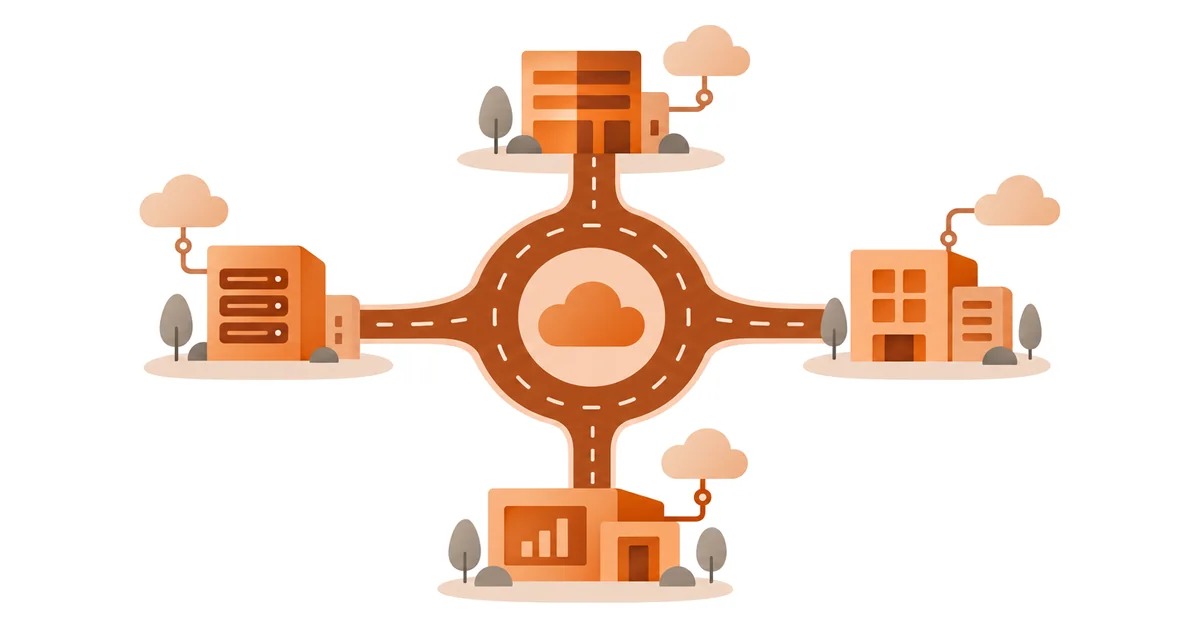
A central hub holds the shared services, and each workload sits in its own spoke. New accounts plug in the same way every time, which keeps the picture simple.
Routing, firewalls and DNS are defined in code, so a change is reviewed before it goes live and can be rolled back.

Your offices and data centers connect to the cloud with redundant links and tested failover, not a single tunnel that everyone hopes will hold.
Bandwidth, latency and cost are compared across VPN and dedicated connection options, so you pay for the capacity you need.
The workloads that benefit first in your sector.
Segmentation, private connectivity and clear audit trails are the baseline. See cloud security consulting for controls beyond the network.
Traffic peaks and global shoppers reward good load balancing and caching. Learn how cloud architecture consulting shapes the whole stack.
Many tenants and environments need a repeatable network pattern. Pair it with cloud infrastructure consulting for automation.
Sites, devices and partners connect to always-on systems. Explore cloud migration consulting for moving the workloads behind the network.
The right partner makes the difference between a network that grows cleanly and one that nobody dares to change. Before you sign, check that your cloud networking consulting partner can show you each of these:
Also ask who holds the admin access and the network documentation after launch. Your team should own both from day one.
See the full price before any build begins.
Full-service, end-to-end consulting at a price that fits a first project.
One contact who knows your project and answers your questions fast.
Least-privilege access, documented changes and NDAs on request.
A cloud networking consultant designs and reviews the network behind your cloud workloads: address plans, virtual networks, routing, firewalls, DNS, load balancing and connections to your own sites. The work ends with a documented design and, often, a built and tested network.
Not always. Small environments with one or two workloads can use a simple design. Hub-and-spoke pays off once you have several accounts or networks that share services such as DNS, firewalls or connections to your offices.
Networks with overlapping ranges cannot be connected without renumbering, which is slow and risky. Planning ranges early for every account, region and site avoids that, and the plan costs almost nothing to make.
A VPN is quick to set up and fine for modest bandwidth. A dedicated connection, such as AWS Direct Connect, Azure ExpressRoute or Google Cloud Interconnect, gives steadier performance and higher capacity at a higher fixed cost. Many companies use both, with the VPN as backup.
Keep chatty services in the same zone, use private endpoints for cloud services, cache content close to users and review which paths carry the most traffic. Your assessment shows the top cost paths with the cheapest fixes.
Yes. Multi-cloud links are possible with VPN, dedicated connections or a transit provider. They add cost and complexity, so your assessment checks whether the need is real before building them.
Segmentation, default-deny rules, private connectivity and logging are part of the design. Rules are stored as code and reviewed, so every change has an author and a reason.
It depends on the number of accounts, regions and sites and on how much you want built. You get a realistic range on your free discovery call and a fixed quote after the assessment.
Get a free assessment call and a clear plan for your network.