Black Friday Without a Crash
“Our shop slowed to a crawl every holiday season. Cloud Hull redesigned the architecture around autoscaling and a managed cache. Peak traffic ran 3x higher than the year before, and page times stayed under two seconds.”
Strategy & Migration
Architecture & Infrastructure
DevOps & Cloud Native
Security & Cost Control
Data & Business Platforms
Your applications get a cloud design that scales with demand, stays secure and keeps the bill in check. You start with a free first call and strategy workshop.

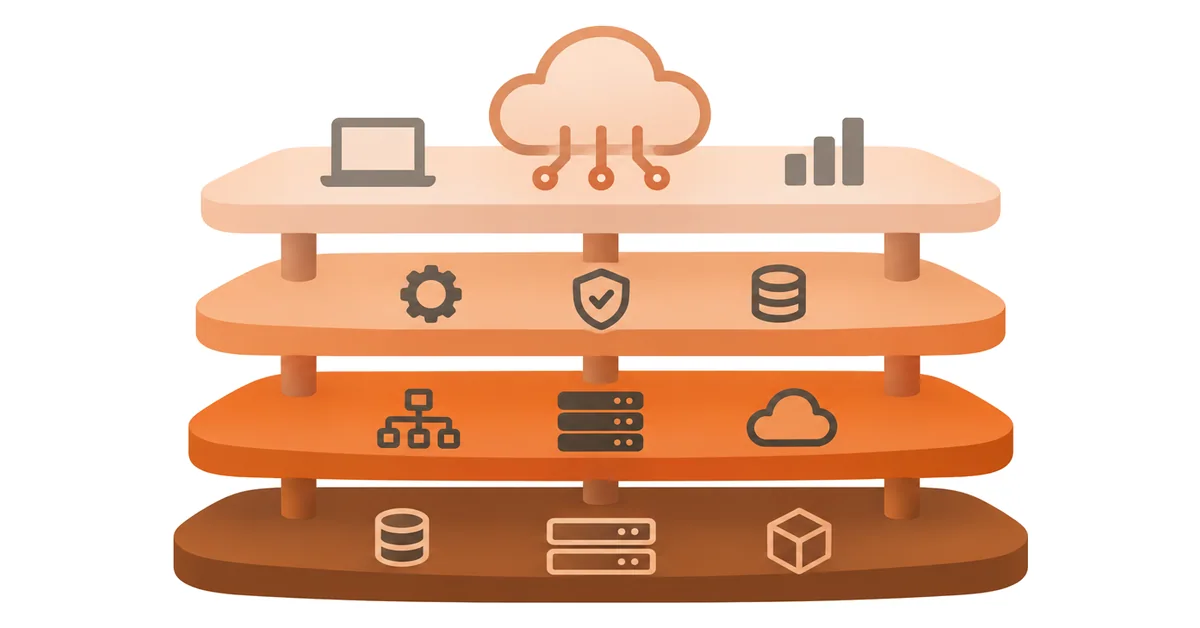
Cloud architecture consulting is a service that designs, reviews and documents how your applications and data run in the cloud, covering accounts, networks, compute, storage, identity, resilience and cost. You start with your business needs and traffic patterns, and the design follows from them.
A sound architecture decides which managed services to use, how workloads are isolated, how traffic is balanced and what happens when a component fails. The major providers publish well-architected frameworks that group these choices into pillars such as security, reliability, performance and cost. A consultant applies them to your case instead of handing you a generic diagram.
In practice, the service covers an architecture review of what you run today, a target design, a landing zone, infrastructure code, a migration or build plan and a handover to your team. You can use one part or the full path.
A good engagement covers the path from first diagram to a design your team can run, so you never end up with a drawing that nobody follows.
Accounts created ad hoc, one-off networks and oversized servers pile up quietly. Yet many teams accept them as the price of moving fast, when a clear design costs less.
Every environment is built a little differently, so deployments take longer and fail in ways that are hard to reproduce.
Engineering time spent on environment surprises
One database in one zone, or one instance behind the shop, takes the whole service down when it fails.
Downtime during your busiest hours
Without tags and an account structure, spend is not tied to products, so nobody can say what to cut.
Idle and oversized resources paid for monthly
Each team handles access and networking its own way, and gaps appear between them that audits find first.
Rework under deadline pressure
The designs that cause trouble later usually copied a reference diagram. Yours starts with how your applications behave: where traffic spikes, which data is sensitive and what an hour of downtime costs you.
From there you get a design that uses managed services where they save effort, keeps components isolated and records each decision with its reason. Your engineers can read it, change it and explain it to an auditor.
Fixing a design after launch costs several times more than getting it right at the start. A good architecture lets you add customers, regions and features without rebuilding, and it shows you where each dollar goes. Start with one workload, prove the pattern and reuse it.
You talk through your applications, traffic and goals. Your consultant asks about uptime needs, data sensitivity and budget, and points out where the design is likely to matter most.
Your current setup is checked against security, reliability, performance and cost standards. You see what works, what is risky and what each fix would return.
The target architecture is drawn, documented and tested with your engineers. Key choices are checked with a small proof of concept or a load test before the build.
Your team builds with guidance, or the build is done for you. A monthly review compares the design with real usage and cost, and updates it as needs change.
Choose a single service or get the full program, from review to build support.
Each workload is checked for security, reliability, performance and cost, with findings ranked by risk.
Diagrams and written decisions show what was chosen, what was rejected and why.
Accounts, identity, networks, logging and budgets set up once, so every team starts safely.
Recovery targets, backups and failover designed for what an outage costs you.
Reviewed, versioned code and documentation, handed over with a walkthrough.
A monthly cost range per environment and tags that tie spend to products.


“Our shop slowed to a crawl every holiday season. Cloud Hull redesigned the architecture around autoscaling and a managed cache. Peak traffic ran 3x higher than the year before, and page times stayed under two seconds.”
“We had a data center lease ending in six months. Cloud Hull sorted our workloads into waves, ran test cutovers and moved 86 of them on schedule. Customers saw no outage, and the lease was not renewed.”
“Releases were a Friday event with three people on call. Cloud Hull built a CI/CD pipeline, added automated tests and set up infrastructure as code. We now deploy daily, and rollbacks take minutes instead of an evening.”
Where the friction is today, and what changes.
Why outside help pays off when you design for the cloud.
Repeatable environments and automated pipelines remove the guesswork from deployments. Your engineers spend their time on features, and rollbacks take minutes.
A consistent account, identity and network model gives every workload the same protection. Audit questions have clear answers, because the design records who can reach what.
Autoscaling, caching and managed data services handle growth and peaks. You add customers and regions to the same pattern, instead of redesigning each time.
Changing a network layout or account structure after launch is costly. Making those choices once, with your goals in front of you, saves months of rework later.
Every project gets a fixed quote after a free discovery call. Here is how the scope usually looks by size.
| Engagement | Scope | Typical length | Price |
|---|---|---|---|
| Architecture review | One to three workloads | 2 to 3 weeks | Fixed quote |
| Target design and landing zoneMost requested | Multi-account foundation and first workloads | 4 to 8 weeks | Fixed quote |
| Design and build support | Design, infrastructure code and guided build | 2 to 4 months | Fixed quote |
After we talk, you get a firm price with no hidden costs.
If a simple design is enough for you, you hear it on the first call, along with what to keep as it is.
You get short weekly updates on what is done, what is blocked and what is needed from you.
You leave the call with a summary of priorities, timing and likely cost that your colleagues can review.

Every workload starts inside the same guardrails. Separate accounts for production and testing, central logging and enforced tags mean problems are contained and costs are visible.
Access follows least privilege and single sign-on. Budgets and alerts are in place on day one, so the first surprise is not the invoice.

Not every system needs the same protection. You set recovery targets by business impact, so critical services get failover and the rest stay simple and affordable.
Backups, failover and recovery steps are tested before launch, and the results are written down for your team and your auditors.
The design questions that matter first in your sector.
Design for strict access control, audit logging, encryption and regional data rules, with a clear record of every decision. Pair the design with cloud security consulting for controls and reviews.
Plan for seasonal peaks with autoscaling, caching and a database that holds under checkout load. See cloud cost optimization consulting to keep peak capacity from inflating your bill.
Build multi-tenant designs that isolate customers and release safely every day. Explore cloud DevOps consulting for pipelines and cloud native consulting for container-based platforms.
Separate sensitive data, log access and keep recovery tested. Your own compliance advisers confirm the rules that apply, and the design keeps the evidence ready.
The right partner leaves you with a design your team understands and can change. Before you sign, check that your cloud architecture consulting partner can show you each of these:
Also ask who maintains the design afterward. You should own the diagrams, the code and the decision records, so the knowledge stays inside your business.
You know the price before the work starts.
Full-service, end-to-end consulting at a price that fits a first project.
One contact who knows your project and answers your questions fast.
Least-privilege access, documented data flows and NDAs on request.
Your consultant designs how your workloads are laid out in the cloud: accounts, networks, compute, data, identity, resilience and cost. You get diagrams, written decisions and a build plan your engineers can follow. If you already have a design, they review it against security, reliability and cost standards and give you a ranked fix list.
AWS, Microsoft Azure and Google Cloud are all covered. Your choice depends on your workloads, your team's skills and your contracts. If you have not picked a provider yet, you get a short, written comparison for your case, with the trade-offs stated plainly.
A review of one workload usually takes two to three weeks. A full target architecture and landing zone design takes four to eight weeks, depending on the number of environments and compliance needs. You get a timeline after the free discovery call.
Both are available. You can take the design and build it with your own team, work together on the first environments, or have the build done for you. Either way, you receive infrastructure code and documentation that your team can own.
Security is part of the design from the start: separate accounts, least-privilege access, encryption, logging and network boundaries. Controls are mapped to the standards that apply to you, and your own compliance advisers confirm the current requirements.
Yes. Designs use autoscaling, caching and managed services sized to your expected peaks, and load tests confirm the numbers before launch. Several ecommerce clients have used this approach to get through holiday peaks without outages.
Cost is a design input. Services are chosen for steady and variable load, resources are tagged by product and owner, and budgets with alerts are set up before launch. Your design includes an estimated monthly cost range.
Architecture decides the design: which services, how they connect and why. Infrastructure work builds, runs and maintains the environments. The two overlap, and many clients use both in sequence.
You get a walkthrough for your team, a backlog of build tasks and optional support during the build. Many clients keep a monthly review to check the design against real usage and cost.
Yes. A startup may need a lean, single-account design that can grow. A larger company may need a multi-account landing zone, regional failover and tight governance. The scope and fixed quote match your size.
Get a free review of your design and a clear plan for your first project.