Main Points
- People problems rank above technology problems in the CNCF survey, led by cultural change at 47%.
- Complexity, security and skills each affect roughly a third of teams.
- Most fixes are small habits: one owner, one paved road, one baseline and one set of numbers.
- Add one capability at a time, and measure before and after each step.
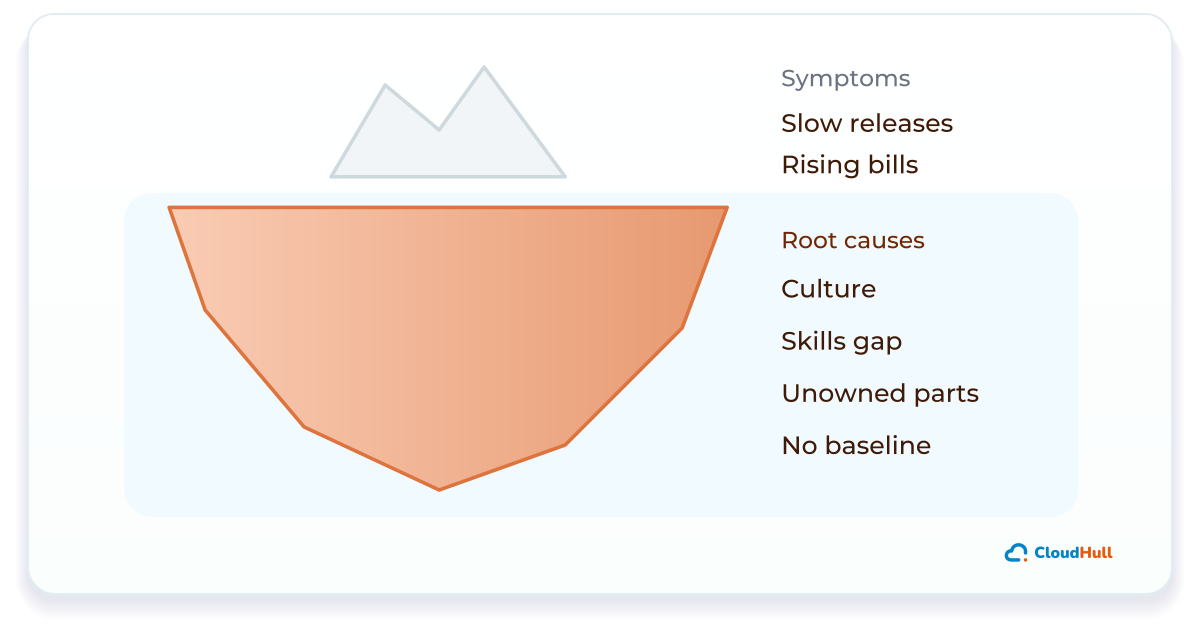
Cloud native projects go wrong in predictable ways. After enough of them, I can often name the problem from the first ten minutes of a call. The symptom is usually a pipeline that people avoid, a cluster nobody wants to upgrade or a bill that nobody can explain.
This article lists twelve challenges in the order I would check them, with the fix for each. If you are earlier in the journey and want help planning around them, a cloud native consulting assessment finds the likely ones before they cost you time.
What the Largest Survey Says
The CNCF 2025 Annual Cloud Native Survey asked organizations what slows them down. Cultural changes within the development team came first at 47%. Lack of training and security were each cited by 36%, and complexity by 34%. All three ranked lower than in previous years, which suggests that tools and guidance are improving while the human side stays hard.
| Challenge in the survey | Share citing it | Where it appears below |
|---|---|---|
| Cultural change in the team | 47% | Challenge 1 |
| Lack of training | 36% | Challenge 2 |
| Security | 36% | Challenge 4 |
| Complexity | 34% | Challenge 3 |
Twelve Challenges and How to Solve Them
I group the challenges by where they start: people, technology, security and cost, operations and strategy. For each, I describe the problem as I meet it, then the fix. The teams that moved fastest tackled the people items first. For a reliable set of habits that prevent many of these, see my list of cloud native best practices.
Teams Resist the New Way of Working
The CNCF 2025 survey lists cultural change within the development team as the top challenge, cited by 47% of respondents. I see it as a trust problem. Developers who were told to use a pipeline they had no say in will find a way around it.
How to solve it: Involve two or three developers in designing the first pipeline, make the new path faster than the old one and keep a visible list of what you removed to make their life easier.
Your Team Lacks Kubernetes and Cloud Skills
Training and skills gaps were cited by 36% of respondents in the same survey. Kubernetes has a steep learning curve, and a team that learns on production tends to learn through incidents.
How to solve it: Train in small, hands-on sessions on a real service, buy a few certifications for the platform engineers, and use managed services for parts that need deep expertise. A short engagement with outside experts can seed the habits.
The Platform Is More Complex Than the Problem
A service mesh, an operator for every database and three monitoring tools can bury a small team. Complexity was named by 34% of respondents. The cost shows up as upgrades that nobody dares to run.
How to solve it: Add one capability at a time. Prefer managed services and defaults. Write down who will upgrade each component and when, and remove anything that has no owner.
Security Falls Behind the Release Speed
Security was cited by 36% of respondents as well. Faster releases bring more images, more secrets and more network paths to protect, and a manual review cannot keep pace.
How to solve it: Move checks into the pipeline: image scanning, signing, policy at admission and least-privilege roles. Use default-deny network policies and a secrets manager. Review access every quarter.
Cloud Costs Grow Faster Than Value
Flexera's 2026 State of the Cloud report puts wasted cloud spend at 29%, the first rise in five years. Kubernetes can hide waste because the bill shows nodes, not teams.
How to solve it: Label every workload with an owner, set requests from measured use, schedule non-production environments to sleep and review spend by team monthly.
The Monolith Resists Being Split
A tangled application has shared tables, hidden dependencies and no clear boundaries. Teams that try to split it all at once end up with a distributed monolith, which is the worst of both worlds.
How to solve it: Containerize it first and put it behind a pipeline. Then extract one service at a time at a clear boundary, using an API in front of the old code. Leave parts that rarely change.
Stateful Workloads and Data Are Hard to Move
Stateless services move easily. Databases, queues and file stores bring consistency, backups and failover, and a mistake costs data instead of time.
How to solve it: Prefer managed database services, rehearse the cutover with a copy of production data and keep a replica of the old system for an agreed period. Move state last.
You Cannot See What Is Happening
In a system of many small services, one slow call can be anywhere. Teams without traces and structured logs spend hours guessing, and alerts on CPU do not tell them what users feel.
How to solve it: Instrument services with metrics, logs and traces from the start, define service level objectives and alert on user impact. Delete alerts that nobody acts on.
Vendor Lock-In Worries Slow Every Decision
Some teams avoid managed services to stay portable, and then pay for it in operations work. Others ignore lock-in until a price change arrives.
How to solve it: Be deliberate. Use open standards such as containers, Kubernetes APIs and OpenTelemetry where they cost little, and accept proprietary services where the value is high. Record each such choice and its exit cost.
Every Team Builds Its Own Setup
Without a paved road, each team picks its own pipeline, base image and monitoring. The result is a dozen ways to do the same thing and a platform team that cannot help anyone.
How to solve it: Offer a default path that is easier than the alternatives, publish service templates and set a few firm rules, such as approved base images and required labels.
The Migration Drags On Without End
Migrations stall when the old and new environments both need care. I have seen teams run both for more than two years because the last ten percent of workloads were always "next quarter".
How to solve it: Set a retirement date for each old environment when the wave is planned. Make the date visible to leadership, and treat a missed date as a decision, not a drift.
Nobody Can Show That It Paid Off
Teams finish a migration and cannot say whether releases got faster or costs fell, because nobody measured the start. Funding for the next phase then depends on opinions.
How to solve it: Record a baseline before the first change and report five numbers each quarter: lead time, deployment frequency, recovery time, change fail rate and cost per service.
Which Challenges to Tackle First
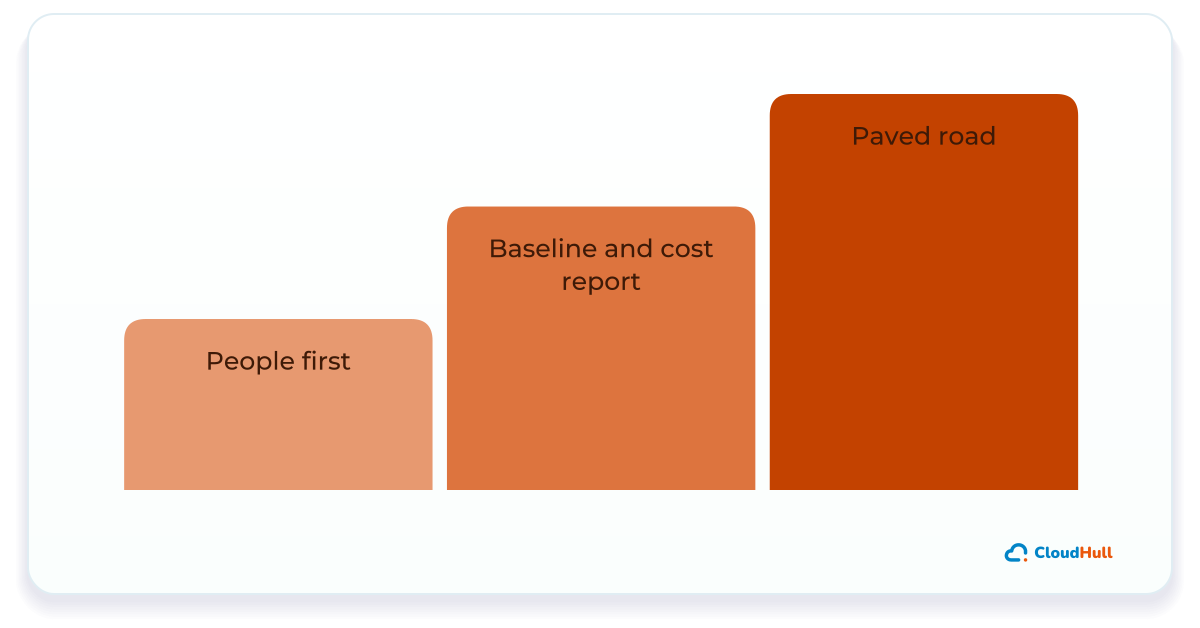
You do not need to solve twelve problems at once. In my client work, three early moves remove most of the pain. Fix the people items first, because everything else depends on goodwill: pick a pilot, involve developers and train on real work. Then put a baseline and a monthly cost report in place, which turns arguments into numbers. Finally, build the paved road, so that new services start from a safe default.
The table maps each group to a first action and to how long it usually takes. The durations come from my projects, and your own results will vary with team size and how much legacy you carry.
| Group | Challenges | First action | Typical time to improve |
|---|---|---|---|
| People | 1, 2 | Pilot with developers, hands-on training | 4 to 8 weeks |
| Technology | 3, 6, 7 | Remove unowned components, scope the monolith split | 1 to 3 months |
| Security and cost | 4, 5 | Pipeline scanning, labels and a monthly report | 2 to 6 weeks |
| Operations | 8, 10 | Service level objectives, service templates | 1 to 3 months |
| Strategy | 9, 11, 12 | Baseline, retirement dates, quarterly review | 2 to 4 weeks to set up |
The order in which to take on these items is easier to see on a timeline, and my cloud native roadmap places them across five phases. The decision about which applications to modernize at all is covered in the cloud native strategy framework.
What It Looks Like When a Team Gets It Right
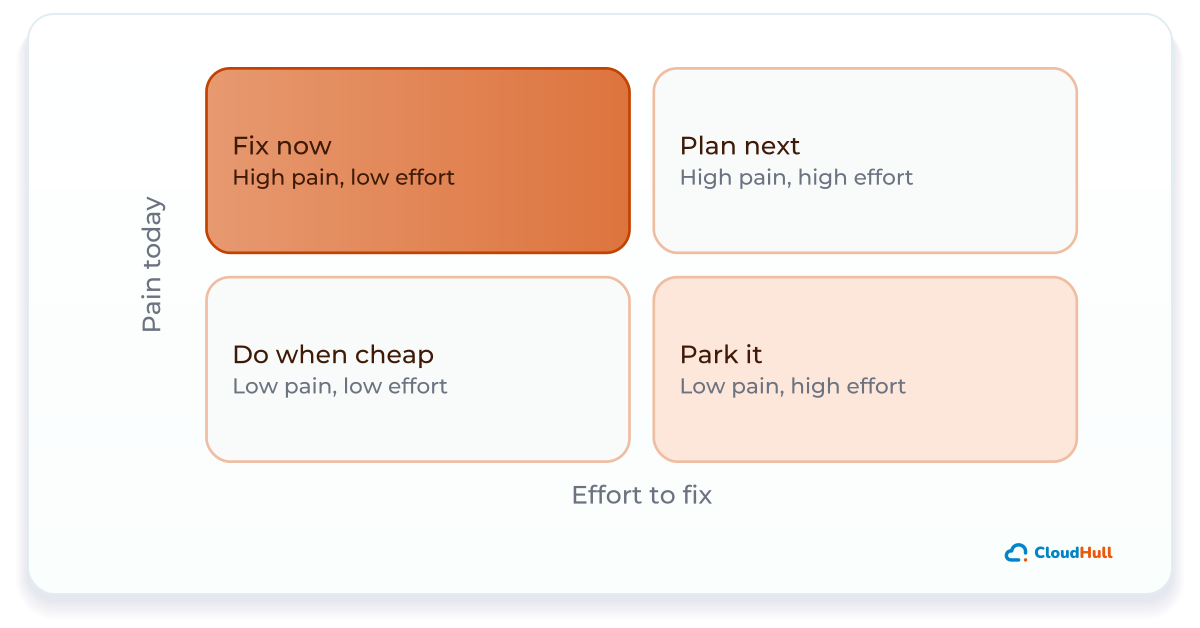
It is encouraging to look at public cases. Nav, a credit platform, moved 25 microservices and a monolith to Kubernetes in about a year, trained its 50 engineers with a week of hands-on labs and reports that resource utilization rose from 1% to 40%. Nubank built a command-line tool and a growing platform team, and now deploys about 700 times a week, according to the CNCF case studies.
Neither story is about avoiding the challenges above. Both teams met them: training gaps, complexity and security zones. What they did differently was to take them one at a time and invest in the people side. You can read more such stories, including my own, in my collection of cloud native examples.
How to Choose Which Hurdle to Fix First
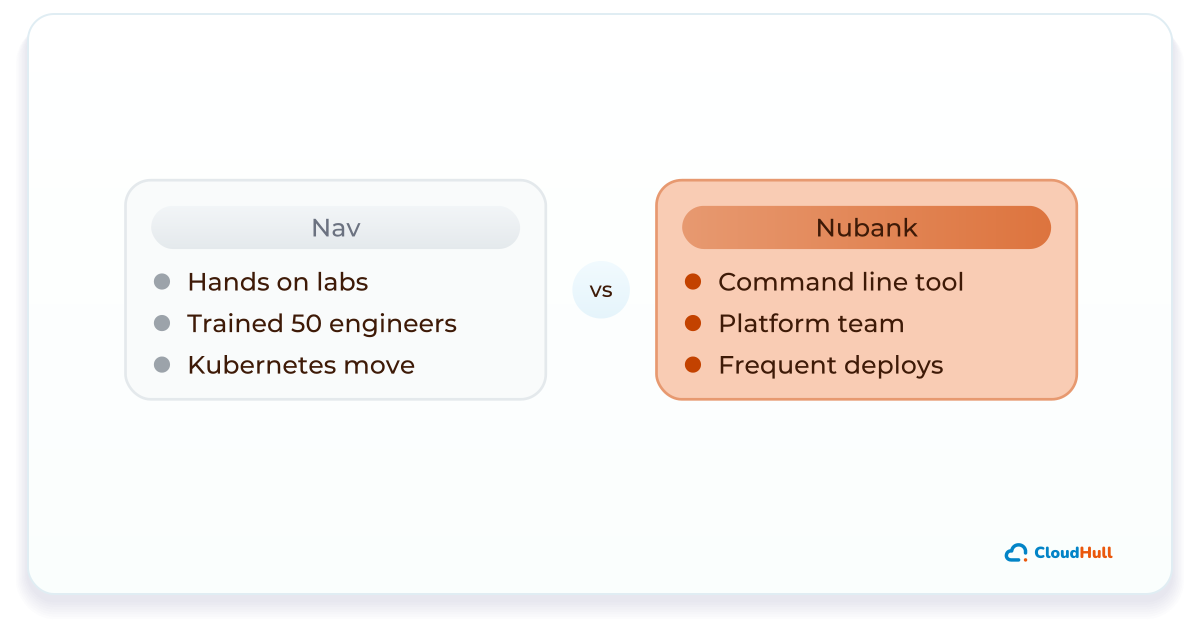
Ask which challenge costs you the most today, and start there. A quick check:
- If developers avoid the new pipeline, start with challenge 1 and 10.
- If nobody wants to upgrade the cluster, start with challenge 3.
- If the bill surprises you each month, start with challenge 5.
- If a security questionnaire is coming, start with challenge 4.
Write the one you chose, the owner and the date you will check the result. That small commitment is worth more than a long list of intentions. If you want an outside view of which hurdle you are likely to hit next, a short assessment can score your setup against all twelve.
Questions About Cloud Native Challenges
What Is the Biggest Cloud Native Challenge?
According to the CNCF 2025 survey, it is cultural change within the development team, cited by 47% of respondents. Technology problems are real, but they are usually easier to fix than a team that does not trust the new way of working.
Is Kubernetes Too Complex for a Small Team?
It can be, if you run everything yourself. Managed Kubernetes, managed databases and a short list of tools make it manageable. Some small teams are better served by a managed container service or a serverless platform.
How Do I Get Developers on Board?
Involve them early, make the new path faster than the old one and respond to their complaints quickly. Champions in each team help more than central mandates.
How Do I Avoid a Distributed Monolith?
Split services around business boundaries, give each its own data and keep calls between services few and well defined. If two services always change together, they probably belong together.
How Much Does a Cloud Native Migration Cost?
People cost usually dominates in the first year, followed by cloud spend and tooling. The total depends on the number of applications and how tangled they are. A short assessment gives you a cost range and a plan for the first phase.
How Do I Keep Cloud Native Costs Under Control?
Label workloads by owner, set resource requests from real usage, use autoscaling and switch off idle environments. Share each team's spend with that team every month.
When Is Cloud Native Not the Right Choice?
When an application is stable, rarely changes and runs cheaply, the effort may not repay itself. A short scoring exercise tells you which applications deserve it and which should stay as they are.
Sources
- CNCF Annual Cloud Native Survey 2025
- CNCF case study: Nav
- CNCF case study: Nubank
- Flexera 2026 State of the Cloud Report
Please note: this guide is general information and not legal, financial or tax advice. Numbers and examples are typical-project estimates; confirm current details with your providers and advisers.
Did this article help you?
Thanks, noted.
Garrett Linville
Garrett leads the Cloud Hull editorial team and works with the consultants to turn real client projects into practical guides on cloud migration, DevOps, security and cost control. Each article is edited together with the consultant who did the work, and every price and limit is checked against current provider documentation. He is based in the USA and works remotely.