Main Points
- Start with a business goal and a baseline, then score every application before you choose a platform.
- Modernize where change rate, scaling need or failure cost is high, and leave stable systems alone.
- Platform and operating model decisions come after the application ranking, not before.
- Review the plan every quarter against five delivery and cost numbers.
Most cloud native strategies are a list of technologies. A good one is a list of decisions: which applications change, which stay, who runs what and how you will know it worked. When I help a team with cloud native consulting, the strategy session decides more of the final result than any tool.
The framework below has five steps. I use it for companies with five engineers and companies with five hundred, and the only thing that changes is how much detail each step needs.
The Five Steps in One Table
| Step | What it answers | What you produce | Typical time |
|---|---|---|---|
| 1. Goals and baseline | Why do this at all? | Two or three measurable goals and today's numbers | 1 to 2 weeks |
| 2. Application scoring | Which applications benefit? | A ranked list with a path for each one | 2 to 4 weeks |
| 3. Platform choices | What to build on? | A short, justified platform decision | 1 to 2 weeks |
| 4. Operating model | Who runs it and how? | Ownership, on-call, access and cost rules | 2 weeks |
| 5. Measure and adjust | Is it working? | A quarterly review with five numbers | Ongoing |
The times are from my own projects and assume a team that can answer questions within a day. They stretch when decisions wait for committees.
Step 1: Pick Goals You Can Measure
Write down why you are doing this in one sentence. Faster releases, a lower run cost, fewer outages, a product that must scale for a launch or a data center exit are all valid. Wanting to be cloud native is not a goal.
Then record where you stand. The DORA research defines five delivery metrics: change lead time, deployment frequency, failed deployment recovery time, change fail rate and deployment rework rate. Pick the ones that match your goal and measure them now, even roughly. Add monthly cloud spend and the number of production incidents. Without that baseline, every later claim of improvement is an opinion.
Step 2: Score Every Application Before You Touch Any
This is the step that separates a strategy from a shopping list. Go through your application portfolio and score each application from 1 to 5 on four questions. How often does it change? How much does its load vary? How costly is a failure? How hard is it to change, given its code, data and dependencies?
Applications that change often, vary in load and hurt when they fail, while being reasonably easy to change, move to the top. Applications that are stable, flat in load and tangled go to the bottom. They are not failures. They are the ones where a rewrite costs more than it returns, and leaving them alone is a legitimate decision.
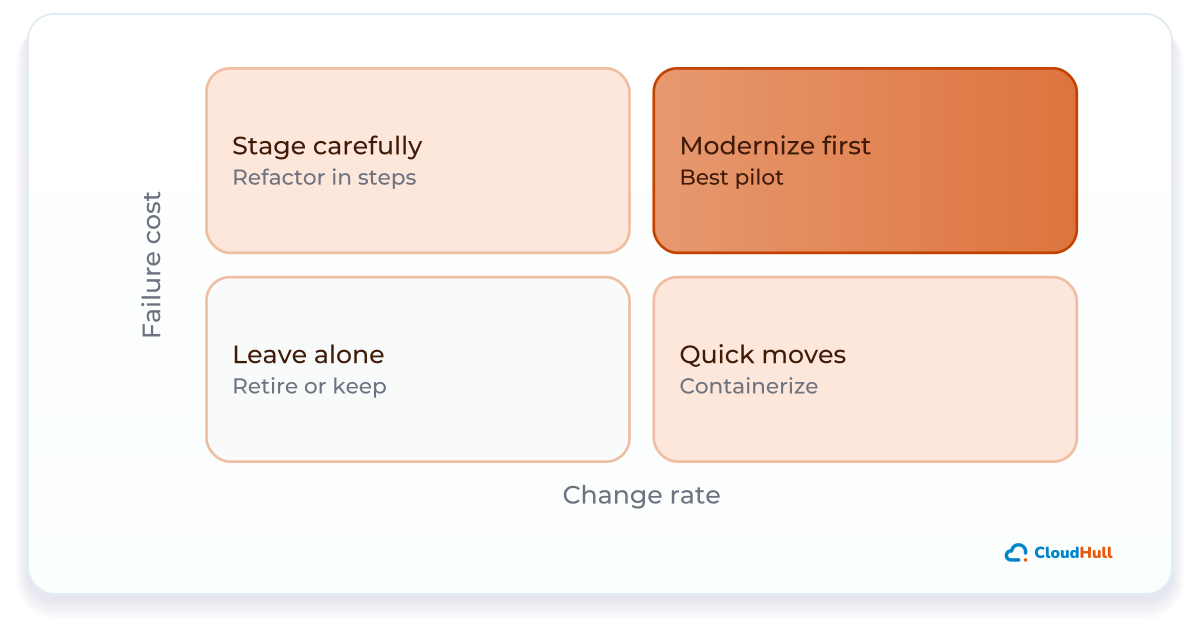
| Score pattern | Typical path | What it means in practice |
|---|---|---|
| High change, high load swings, easy to change | Containerize and automate first | Quick payback, good pilot candidate |
| High change, hard to change | Refactor in stages | Extract one service at a time behind an API |
| Low change, flat load | Leave in place or lift and shift | Move only if a contract or data center forces it |
| Low value, low use | Retire | Cheapest modernization there is |
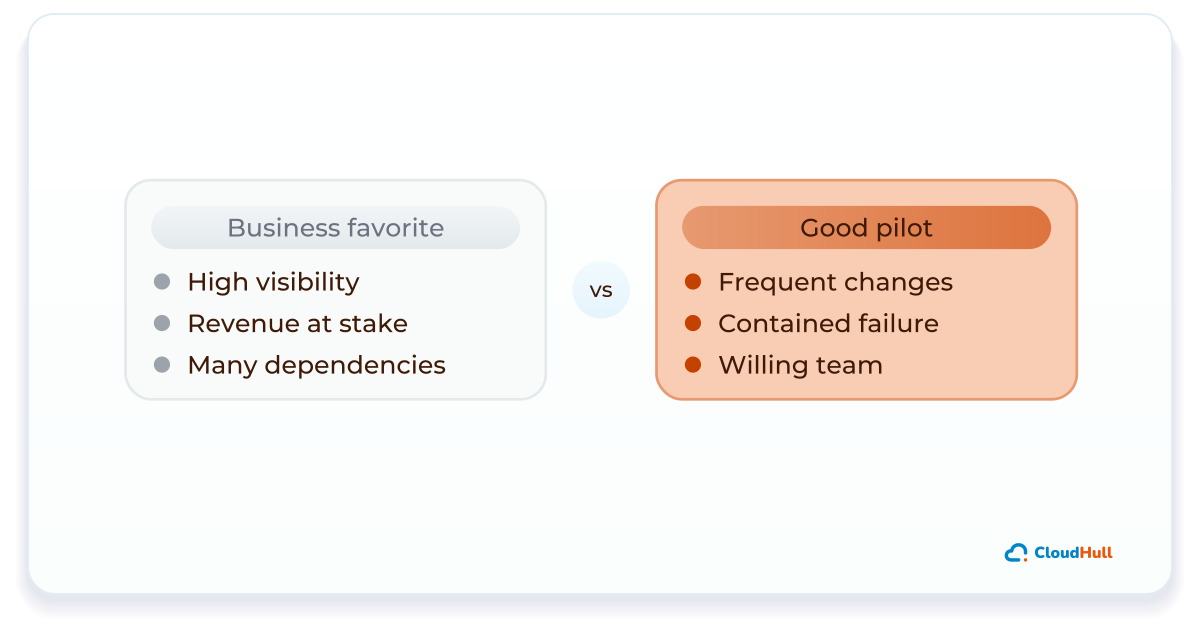
One caution from client work: the application the business loves most is often the worst first project, because every stakeholder has an opinion about it. Pick a visible but not critical one. For a way to see how these choices played out, look through my cloud native examples.
Step 3: Choose the Platform After the Ranking
Now, and only now, choose tools. The decision has three layers: where containers run, how code reaches them and how you see what happens. For the first layer you pick between managed Kubernetes, a simpler managed container service and serverless functions. For the second, a pipeline and a GitOps controller. For the third, a metrics, logs and traces stack.
The ranking drives the choice. A handful of services with spiky traffic often run well on a managed container service or serverless. A large portfolio with many teams, shared platform needs and portability goals usually justifies Kubernetes, and the 2025 CNCF survey reports that 82% of container users run it in production. Popularity is not a reason by itself, though. Kubernetes brings upgrades, networking and security work that you will own.
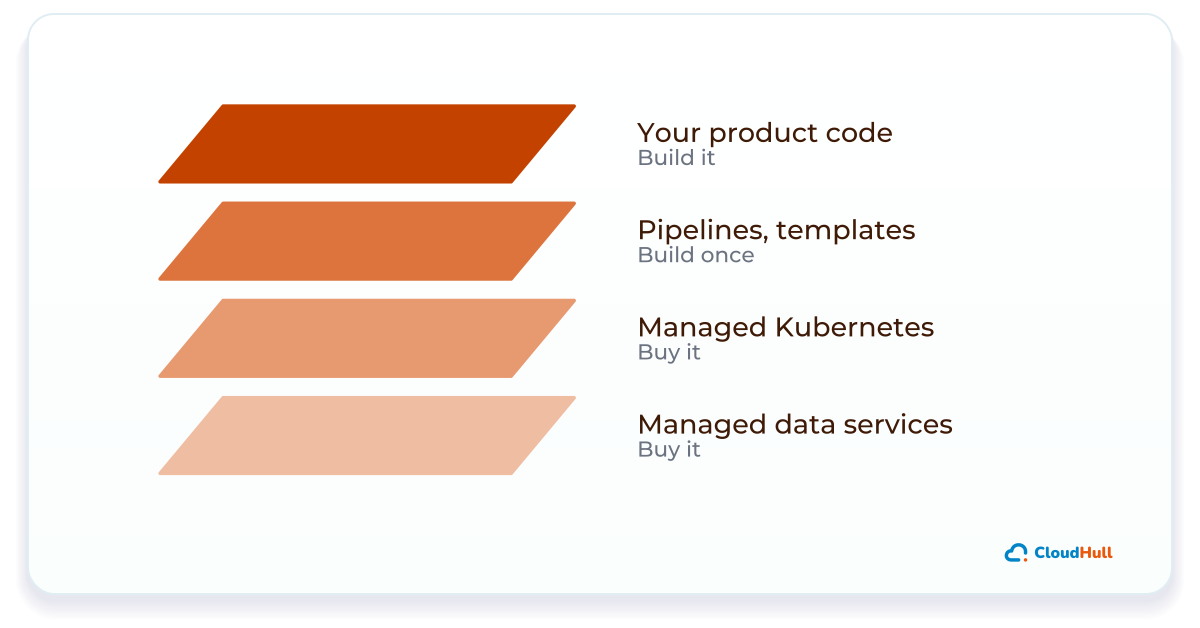
Prefer managed offerings for the parts that do not differentiate you. Running your own control plane is rarely where a business earns money. When it comes to infrastructure code, choose one tool and one module structure, so that environments look the same. My guide to cloud native best practices lists the habits that make that choice stick.
Step 4: Decide Who Runs What
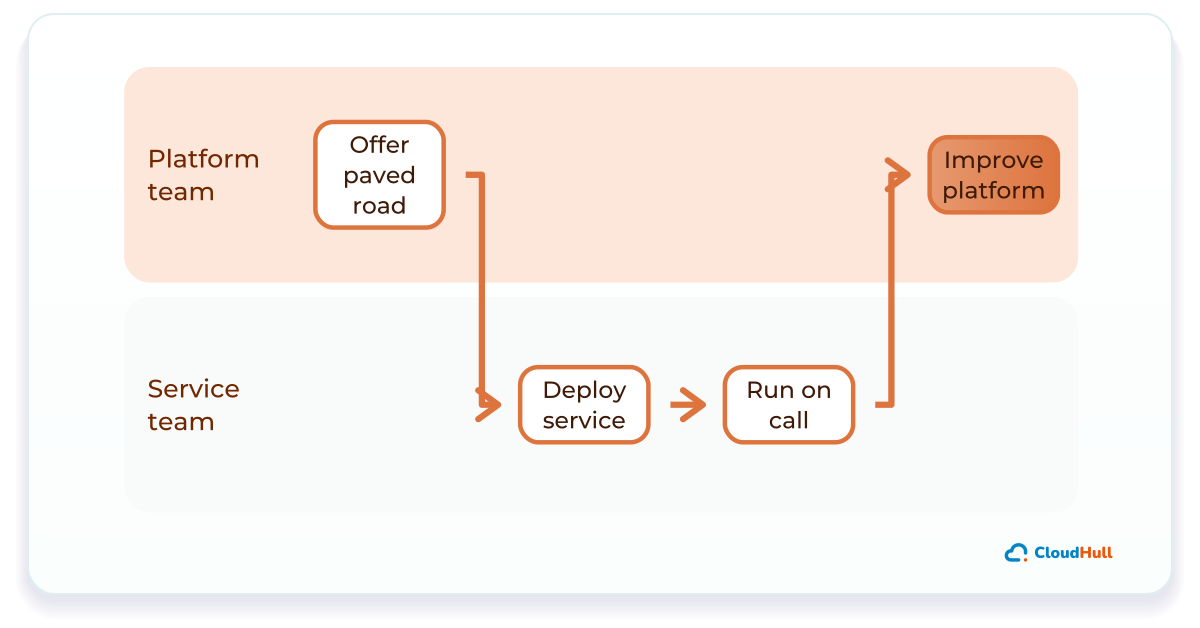
A platform without an operating model becomes a source of tickets. Decide four things on paper before launch.
- Who owns the platform itself: upgrades, shared tooling and the paved road for new services.
- Who owns each service: code, on-call and cost, usually the team that builds it.
- How access works: least privilege, short-lived credentials and a review every quarter.
- How spend is shown: labels by team and service, and a monthly review with the people who can change it.
Flexera's 2026 State of the Cloud report estimates that 29% of cloud spend is wasted, the first rise in five years. The usual cause is that nobody owns the number. Putting a name next to each service's cost fixes more than any tool does.
The people side deserves the same attention. In the CNCF survey, cultural change within the development team was the top challenge at 47%. Plan training and a few champions in each team, and give people time to learn. The cloud native challenges I see most often are listed in a separate guide, along with fixes.
Step 5: Measure, Review and Adjust
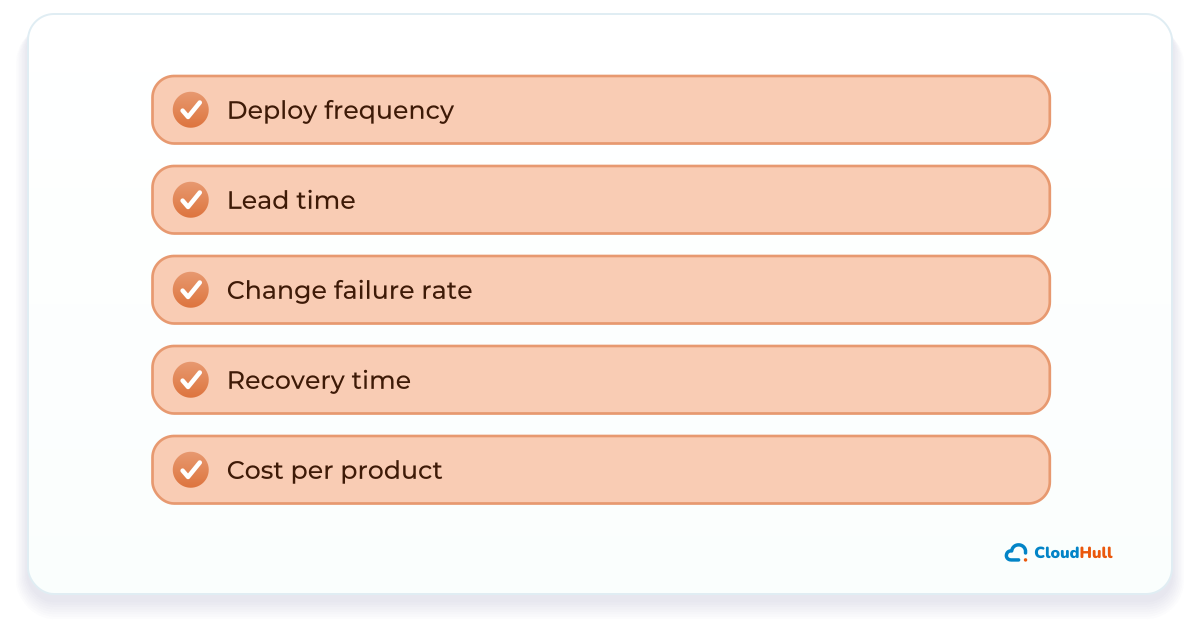
Hold a review every quarter with five numbers: lead time for changes, deployment frequency, recovery time, change fail rate and cost per service. Compare them with your baseline. Two quarters of flat numbers mean the plan is not working, and the right response is to change the plan, not to add more tools.
Keep the strategy document short enough to read in ten minutes. List the goals, the ranked applications, the platform decision, the operating rules and the dates. When priorities shift, edit the list, not the structure. For the timeline that turns this into milestones, see my cloud native roadmap.
A Worked Scoring Example for a Mid-Sized Retailer
To make step 2 concrete, here is a scoring round from a project I ran for an online retailer. The names are generic, and the scores are my own judgment from that engagement. The team had six applications and budget for two modernization projects.
| Application | Change | Load swings | Failure cost | Ease | Decision |
|---|---|---|---|---|---|
| Storefront | 5 | 5 | 5 | 3 | Refactor in stages |
| Search service | 4 | 4 | 3 | 4 | Containerize first, pilot here |
| Order management | 3 | 4 | 5 | 2 | Wrap with APIs, later |
| Reporting | 2 | 2 | 2 | 4 | Lift and shift |
| Supplier portal | 1 | 1 | 2 | 3 | Leave as is |
| Old returns tool | 1 | 1 | 1 | 2 | Retire |
The storefront scored highest, but it was also the application that every executive watched. The search service scored almost as high, was easier to change and could fail without stopping sales. I recommended starting there, and the team agreed. The pipeline, monitoring and cost labels built for search were then reused for the storefront, which had a much smoother first quarter than it would have had as the pilot. Order management waited until APIs existed around it.
The returns tool was simply switched off after a usage check showed three requests a month, and that saved a server and a support contract. Retiring is often the cheapest result of a scoring round, and the one teams are slowest to consider.
Strategy Mistakes I See Most Often
Three mistakes account for most of the stalled programs I have been asked to rescue. The first is choosing the platform first, which locks in a design before anyone knows what it must run. The second is a strategy with no baseline, so nothing can be shown to have worked. The third is treating every application the same, which spreads a small team across fifty migrations and finishes none.
A fourth appears in larger companies: the strategy belongs to a central group that does not run the systems. Engineers read it as a mandate and work around it. Bring the people who will operate the platform into steps 2 and 3, and the plan gets owners instead of critics.
How to Choose Where to Spend Effort First
If your budget covers only part of the framework, I suggest steps 1 and 2. A clear goal and a ranked application list already change what you do next, even without a finished platform design. Steps 3 to 5 can follow as you learn. Check your plan against four questions before you commit money:
- Can you state the goal and its baseline in two sentences?
- Does every application on the list have a path, including "leave as is"?
- Is there one named owner for the platform and one for each service?
- Do you know the date of the first review?
If any answer is no, fix it before buying anything. An outside assessment can speed this up, because someone who has not argued about these applications for years can score them without politics.
Questions About Building a Cloud Native Strategy
What Is a Cloud Native Strategy?
It is a written plan for which applications you will build or modernize with containers, automation and cloud services, in what order, with which platform and with what results expected. A good one fits on a few pages and names owners and dates.
How Is a Cloud Native Strategy Different from a Cloud Strategy?
A cloud strategy covers the whole move to the cloud, including where each workload runs, contracts and governance. A cloud native strategy goes deeper on how applications are built and operated: containers, delivery pipelines, service design and observability. You need both, and the second sits inside the first.
Which Applications Should Be Cloud Native?
The ones that change often, need to scale with demand or hurt when they fail. Stable internal tools that rarely change usually do not repay the effort. I score each application on change rate, scaling need and failure cost before I recommend anything.
How Long Should a Cloud Native Strategy Cover?
Plan in detail for the next two quarters and in outline for the next two years. Technology and team skills change fast enough that a five-year plan is mostly fiction.
Who Should Own the Strategy?
One named person with authority over both engineering and budget, usually a head of platform or a CTO. A strategy with a committee as owner tends to stay a document.
How Much Does It Cost to Put a Strategy in Place?
The cost depends on how many applications you review and how deep the assessment goes. Many teams start with a fixed-price assessment that produces the ranked list and the first phase plan, and you can get a cost range on a free discovery call.
How Do I Know the Strategy Is Working?
Track a handful of numbers against your baseline: lead time for changes, deployment frequency, recovery time, change fail rate and cost per service. If they move in the right direction quarter after quarter, the strategy works. If they do not, change the plan.
Sources
Please note: this guide is general information and not legal, financial or tax advice. Numbers and examples are typical-project estimates; confirm current details with your providers and advisers.
Did this article help you?
Thanks, noted.
Garrett Linville
Garrett leads the Cloud Hull editorial team and works with the consultants to turn real client projects into practical guides on cloud migration, DevOps, security and cost control. Each article is edited together with the consultant who did the work, and every price and limit is checked against current provider documentation. He is based in the USA and works remotely.