Main Points
- Score six dimensions from 1 to 5: strategy, workloads, security, cost, skills and delivery.
- Score what you can prove today, not what you plan to build.
- Read your lowest score first, because the weakest dimension limits everything else.
- Have an outside person challenge every score of 4 or 5 to remove optimism.
A cloud strategy assessment tells you how ready your organization is to move, run or restructure workloads in the cloud, and what to fix first. If you want it run for you, a cloud strategy consulting engagement usually starts with exactly this exercise.
Below I show the six dimensions I score, a rubric you can use on your own, the five steps to run the assessment and how to read the results. You can finish a first pass in a week.
What a Cloud Strategy Assessment Actually Measures
An assessment compares where you are with where you need to be for the goals you set. It does not judge your engineers or your current provider. It finds the gaps between your ambition and your foundations, so you can spend money in the right order.
It differs from a technical migration review, which looks at individual workloads. A strategy assessment looks at the organization around them: decisions, money, security, skills and delivery. Both matter, and the strategy view comes first because it decides how many workloads are worth moving at all. If you want the checkpoints that follow, the cloud strategy checklist turns the findings into a verification list.
The Six Dimensions and How to Score Them
Score each dimension from 1 to 5. Use the descriptions as anchors and score the level you can prove, not the level you intend to reach.
| Dimension | Level 1 | Level 3 | Level 5 |
|---|---|---|---|
| Strategy and governance | Team-by-team decisions | Written goals and a sponsor | Quarterly cloud board with budget authority |
| Workloads and architecture | Outdated spreadsheet | Inventory with owners | Live inventory tied to billing and monitoring |
| Security and compliance | Per-team rules | Shared baseline, manual checks | Guardrails as code, exceptions reviewed |
| Cost control | One shared bill | Tags and monthly report | Per-workload forecast and alerts |
| Skills and operating model | Two heroes | Named roles, some gaps | Platform team, training paths, partner |
| Delivery and operations | Manual deploys | Pipelines for some services | Automated, infrastructure as code, tracked recovery |
Strategy and Governance
Do you have written cloud goals, an executive sponsor, decision rights and a budget owner? Level 1 means cloud decisions happen team by team. Level 5 means a standing cloud board reviews spend, risk and progress every quarter.
Workloads and Architecture
Do you know what you run, what depends on what and which workloads fit the cloud? Level 1 is a spreadsheet nobody updates. Level 5 is a living inventory tied to billing, monitoring and a placement decision per workload.
Security and Compliance
Are identity, network, encryption and logging defined as a baseline? Level 1 means each team sets its own rules. Level 5 means guardrails enforced as code, with exceptions logged and reviewed.
Cost and Financial Control
Can you trace every dollar of cloud spend to a team and a product? Level 1 is one shared bill. Level 5 is forecasting per workload, budgets with alerts and a monthly review that leads to action.
Skills and Operating Model
Who builds, who runs and who is on call? Level 1 is one or two people who know everything. Level 5 is defined platform and product roles, training paths and a partner for peak demand.
Delivery and Operations
How do changes reach production and how fast do you recover from failure? Level 1 is manual deploys and tickets. Level 5 is automated pipelines, infrastructure as code and measured recovery times.
Most organizations I assess score between 2 and 3 on average, with a sharp spike in one dimension. A team with strong delivery and weak cost control is common. So is a company with strict security policy and no landing zone to apply it in.
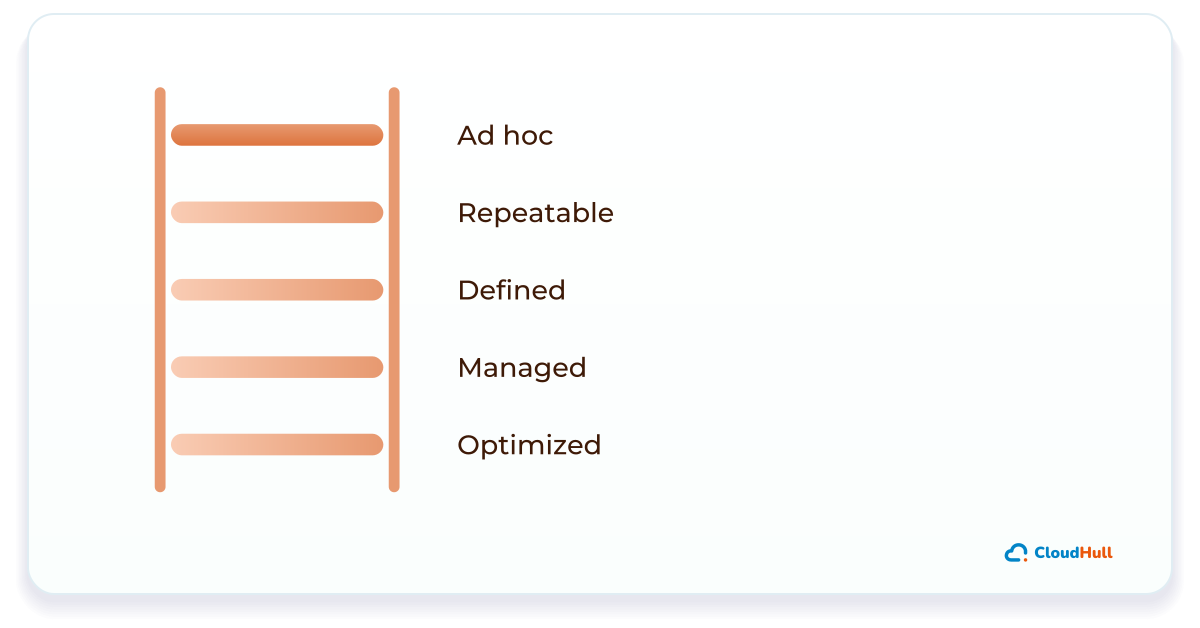
Five Steps to Run the Assessment
You can run this with a small group in about a week. Block calendar time up front, because the interviews are what take time.
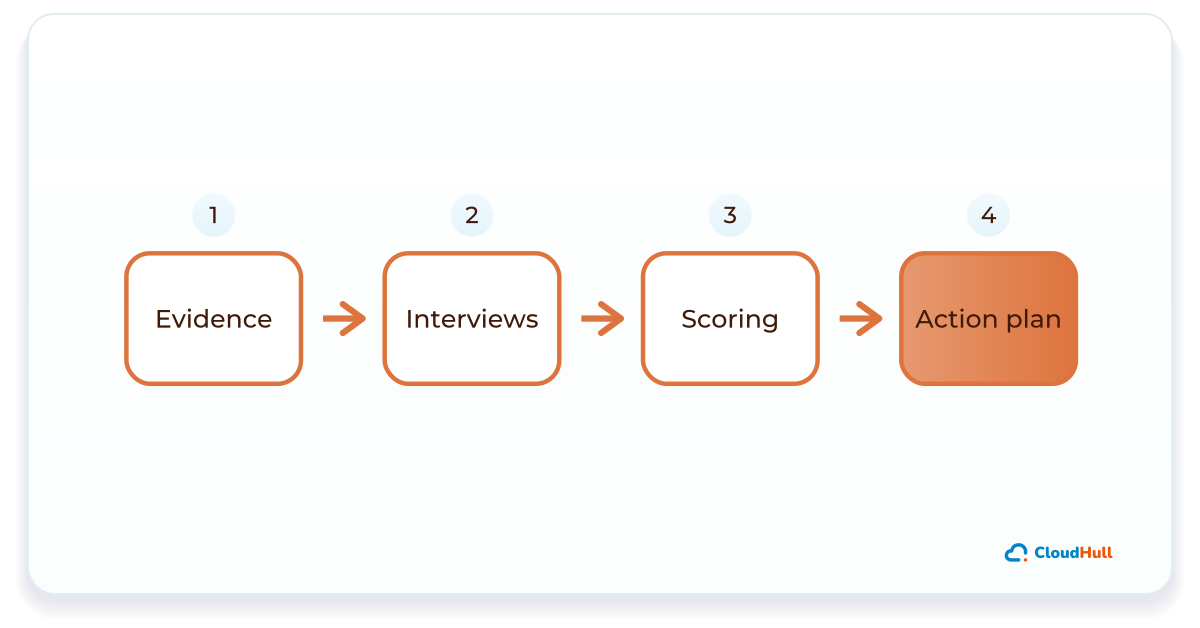
- Name the goal. Write the outcome you want, such as lower cost, a data center exit or faster releases, because readiness only means something against a goal.
- Collect evidence. Gather the inventory, the last three cloud bills, access policies, pipeline definitions and any existing strategy document.
- Interview five to eight people. Talk to engineering, security, finance, operations and one business owner. Ask what breaks, what takes too long and what nobody owns.
- Score each dimension. Use the rubric, write one sentence of evidence per score and have a second person challenge any score of 4 or 5.
- Rank the gaps. Sort the gaps by how much they threaten your goal, and pick the three to close first.
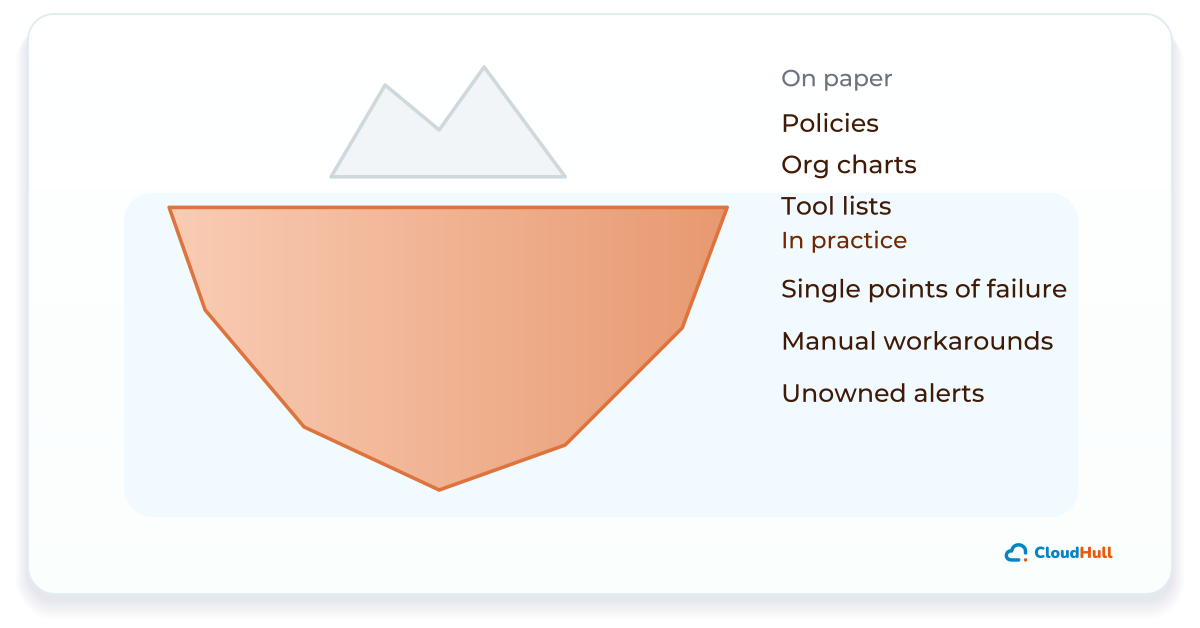
The interviews catch what documents hide. In one assessment for a payments company, the written access policy was solid, but three engineers described the same workaround for getting production access in a hurry. The policy scored a 4 and the practice a 2. I recorded a 2.
Reading Your Results Without Fooling Yourself
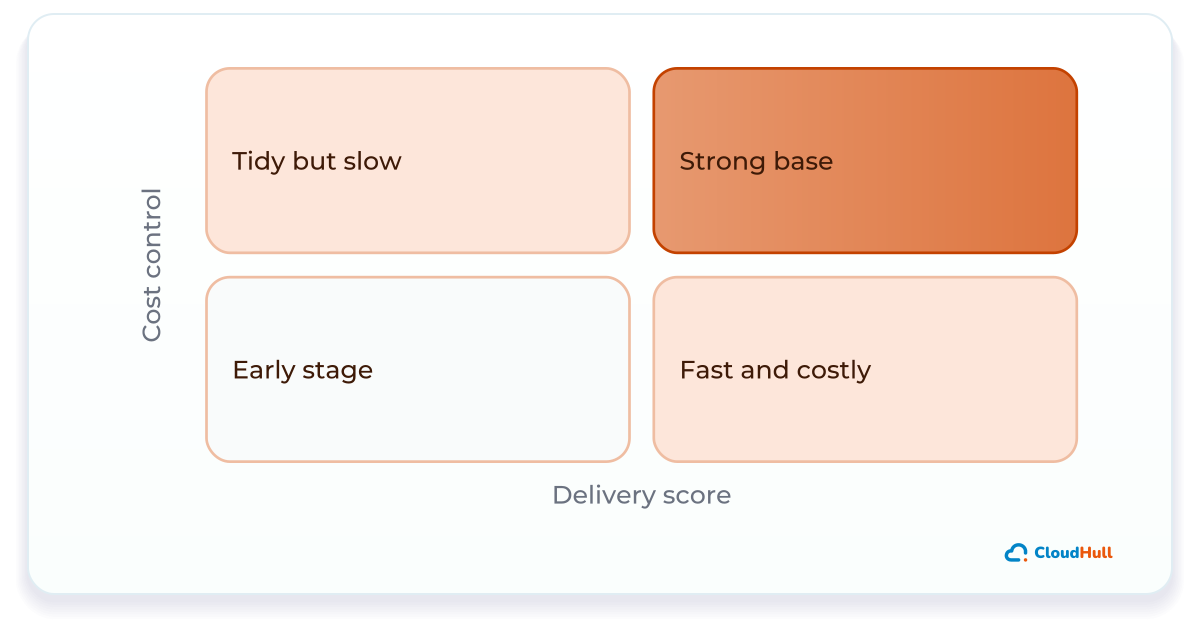
Look at the lowest score first, because your weakest dimension limits everything else. Excellent pipelines do not help if you cannot see what they cost, and strong governance does not help if nobody can deploy safely.
| Pattern | What it usually means | First move |
|---|---|---|
| Low on everything | You are early, which is fine | Write goals, build the inventory, set a security baseline |
| High delivery, low cost control | Teams ship fast and spend freely | Tagging, budgets and a monthly review owner |
| High governance, low delivery | Plenty of policy, little automation | Pipelines and a landing zone built as code |
| High security, low skills | Controls depend on a few people | Training, documentation and a partner for peak work |
| Even scores of 3 | Solid base, no single weak point | Pick one dimension per quarter to move to 4 |
Once you know your gaps, decide the order in which to close them. The cloud strategy roadmap shows how to put gaps, milestones and budget on one timeline. For the structure behind the dimensions, see the cloud strategy framework, and for finished projects that started from a low score, read the cloud strategy examples.
What Evidence to Ask For in Each Dimension
A score without evidence is an opinion. Ask for one or two concrete items per dimension and write down what you saw.
- Strategy and governance: the approved goal document, the budget owner's name and the minutes of the last cloud steering meeting.
- Workloads and architecture: the inventory, a dependency map for your top five applications and the list of workloads already marked for retirement.
- Security and compliance: the access review from the last quarter, the logging setup and the list of open findings from your latest audit.
- Cost and financial control: the last three bills, the tagging policy and the percentage of spend you can assign to a team.
- Skills and operating model: the on-call rota, the training record and a list of tasks that only one person can do.
- Delivery and operations: the pipeline definitions, deployment counts for the last month and the time it took to recover from your last outage.
The last item in each list is the useful one. Single points of failure, unowned budgets and unrecovered outages show up there faster than anywhere else.
A Worked Example From a Mid-Sized Retailer
Here is a pattern from my client work, with details changed. An online retailer wanted to move its storefront and order system to the cloud before the next peak season. Their self-score was 3.6 on average, and the leadership team felt ready.
The assessment gave a different picture. Delivery scored a 4, because the team deployed several times a week. Cost control scored a 1, since all spend landed on one account with no tags. Security scored a 2, because three admin accounts were shared. The average was 2.7, and the lowest scores sat exactly where a peak-season move would hurt most.
The plan changed from "move everything by October" to three steps: tag and split the accounts, fix the shared admin access, then move the storefront. The move happened one season later than hoped, and nobody got a surprise bill or an emergency password reset during Black Friday.
Four Ways Assessments Lose Their Value
The first is scoring against the plan instead of the facts. The second is skipping interviews, which leaves you with documents that describe policy instead of practice. The third is treating the score as a grade, which makes people defend their numbers instead of explaining their problems. The fourth is filing the result. Put the three biggest gaps into the next quarter's work plan with owners and dates, and review them at the next meeting.
Keep the tone constructive when you present the result. Show the dimensions as a map of where to invest, and credit the teams whose area scored well.
Self-Assessment or Outside Assessor?
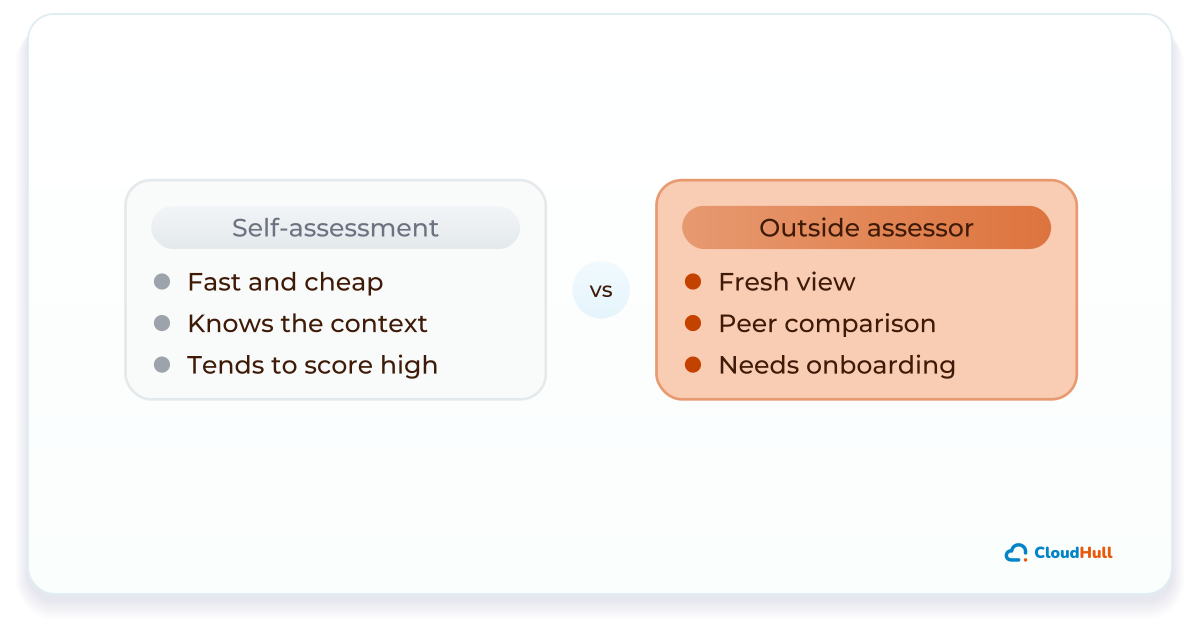
A self-assessment is quick and costs only time. Its weakness is bias: people score the work they did generously and the work of other teams harshly. An outside assessor brings benchmarks from other organizations and no stake in the answer. I suggest an outside view when a board or an investor will read the result, when the cloud budget is large or when your last two attempts at a cloud program stalled.
A good compromise is to run the self-assessment first, then have an outside person challenge only the scores of 4 and 5. That costs a few hours and removes most of the optimism.
Questions About Cloud Strategy Assessments
How Long Does a Cloud Strategy Assessment Take?
A self-assessment with five to eight interviews takes about a week of part-time effort. An outside assessment of a mid-sized organization usually runs two to four weeks, depending on how quickly you can provide inventory, billing data and interview slots.
What Do I Need Before I Start?
You need a written goal, your last three cloud bills or data center cost figures, a rough application inventory, your access and security policies and any existing strategy documents. Missing documents are findings in themselves, so start anyway.
Is a Cloud Strategy Assessment the Same as a Security Assessment?
No. Security is one of six dimensions here. A dedicated cloud security assessment goes much deeper into configuration, identity and monitoring. The strategy assessment tells you whether security is a gap relative to your plans.
Who Should Be Interviewed?
Talk to engineering, security, finance, operations and at least one business owner of a major application. Include someone who joined recently, because new people notice what long-time staff have stopped seeing.
What Does a Good Score Look Like?
A 3 across the board is a healthy base for a first migration wave. You do not need 5s everywhere. You need no dimension below 2 and a clear plan to lift the weakest one before you scale up.
How Often Should I Reassess?
Reassess every six to twelve months, and after any major event such as an acquisition, a new provider or a security incident. Keep the rubric the same so you can compare scores over time.
Can I Do the Assessment Without Outside Help?
Yes. The rubric above is enough for a first pass. Bring in an outside person to challenge your highest scores and to benchmark your results, since that is where self-assessments are weakest.
Please note: this guide is general information and not legal, financial or tax advice. Numbers and examples are typical-project estimates; confirm current details with your providers and advisers.
Did this article help you?
Thanks, noted.
Garrett Linville
Garrett leads the Cloud Hull editorial team and works with the consultants to turn real client projects into practical guides on cloud migration, DevOps, security and cost control. Each article is edited together with the consultant who did the work, and every price and limit is checked against current provider documentation. He is based in the USA and works remotely.