Main Points
- Run six phases in order: align, discover, decide, build the foundation, migrate in waves and operate.
- Every phase ends with a gate and a piece of proof, so you never move on by assumption.
- Stay provider-neutral until phase 3, then borrow the provider's own framework for details.
- Keep the foundation small and test it with a throwaway workload before real ones arrive.
A framework earns its place when it tells you what to do on Monday. The six-phase model below is the one I use with clients, built on the same ideas as the big provider frameworks and trimmed to what a mid-sized team can actually run. If you would rather have it applied to your estate, the cloud strategy consulting service I work with follows this structure.
Each phase has a purpose, an output and a gate. You do not move on until the gate is passed. That discipline matters more than the phase names.
The Six Phases and What Each One Produces
| Phase | Timing | Main output |
|---|---|---|
| 1. Align on Outcomes | Weeks 1 to 2 | Goals with numbers, an executive sponsor, a budget range |
| 2. Discover the Estate | Weeks 2 to 5 | Inventory, dependency map, baseline cost and skills list |
| 3. Decide Placement and Provider | Weeks 5 to 7 | Placement per workload, provider choice, target architecture |
| 4. Build the Foundation | Weeks 6 to 12 | Landing zone, identity, network, guardrails, cost tagging |
| 5. Migrate and Modernize in Waves | Months 3 to 12 | Wave plan, cutover runbooks, rollback procedures |
| 6. Operate and Optimize | Ongoing | Monthly cost review, quarterly strategy review, runbooks and metrics |
Timing depends on size. A company with 30 workloads can compress phases 1 to 3 into a month. A company with 800 will take a quarter, and phase 5 can run for years. The sequence holds either way.
Phase 1: Align on Outcomes
Write the outcomes your cloud program must deliver, such as a 25 percent lower hosting bill, daily releases or a closed data center. Rank them, because you will have to trade them off later. Cost, speed and risk pull in different directions, and the ranking tells everyone which one wins.
Get one executive to own the goals. Programs without a named sponsor lose their budget at the first reorganization.
Ask the sponsor to rank cost, speed and risk. If the answer is "all three equally", you do not have a ranking yet.
Phase 2: Discover the Estate
List every application, owner, dependency, data store and license. Pull your current run cost, whether that is a data center, colocation or an existing cloud bill. Note the skills you have and the ones you lack.
Combine three sources: the CMDB, network flow data and the finance ledger. Each one is wrong in a different way, and the gaps between them show you what you forgot.
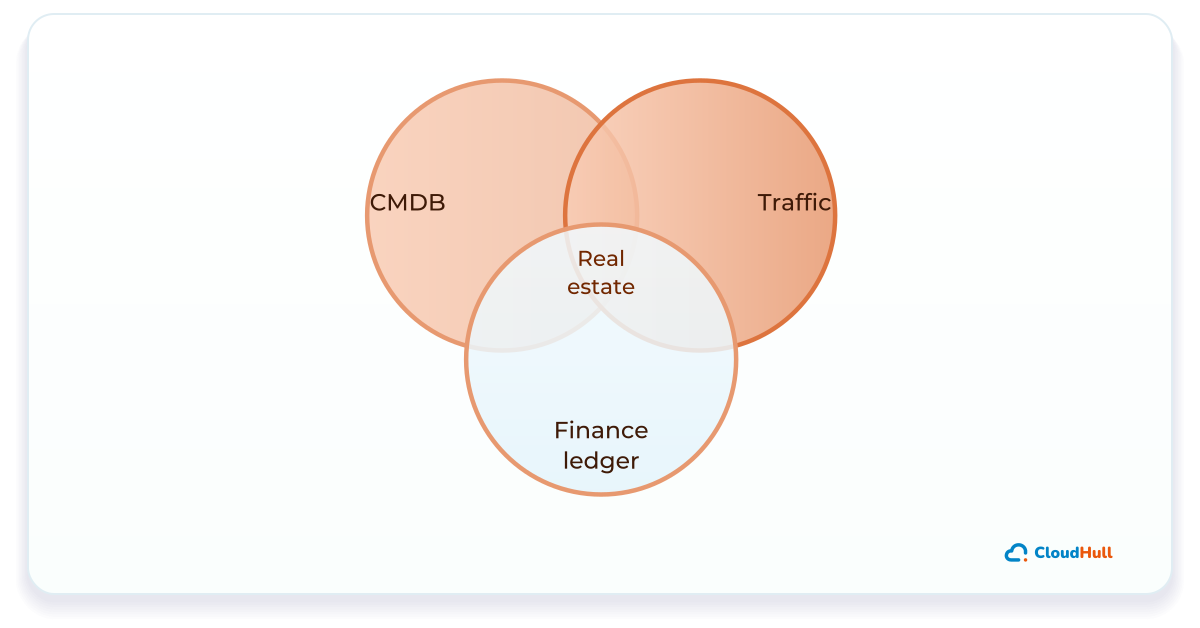
Tools such as the discovery services from the main cloud providers help, but expect to fill gaps by interview.
The rubric to score what you find lives in the cloud strategy assessment, which fits naturally here.
Phase 3: Decide Placement and Provider
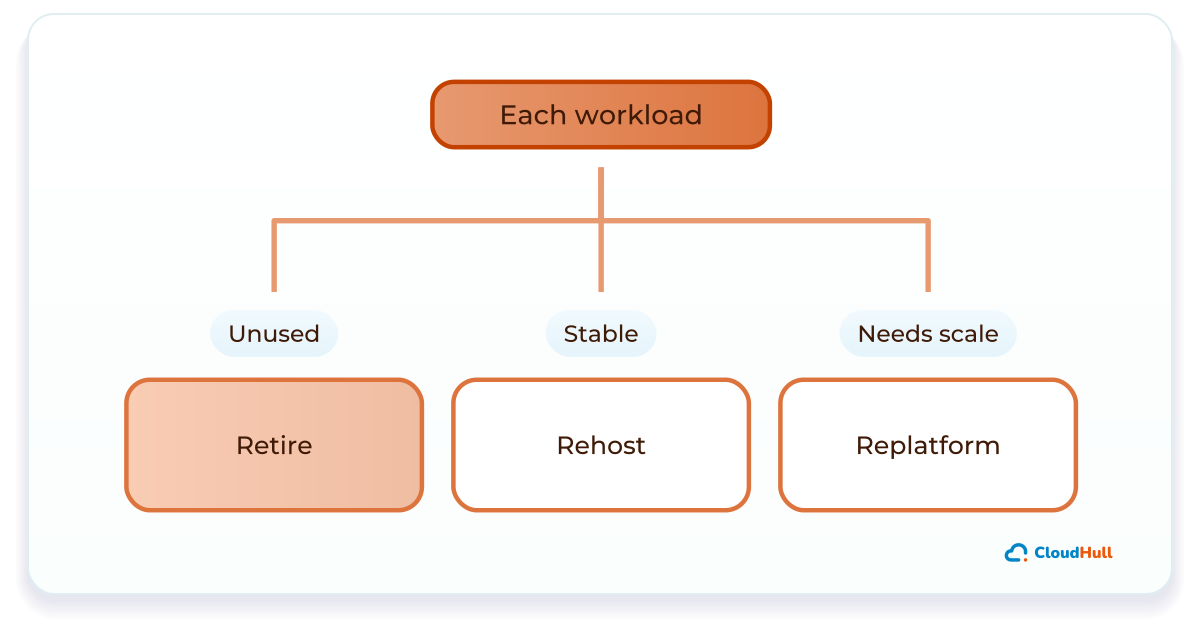
Choose rehost, replatform, refactor, replace, retain or retire for each workload. Then choose your provider or providers using criteria you wrote down in advance: existing contracts, team skills, required services, data residency and exit cost.
Be wary of refactoring everything. Refactoring pays when a workload needs elasticity or faster change. For a stable internal tool, a lift and shift is often the better deal.
Write the exit plan now. If you cannot describe how you would leave a service, you are about to take on a dependency you do not understand.
Phase 4: Build the Foundation
Create the account structure, network layout, identity model and policy guardrails, all as code. Add tagging rules and budgets before any workload arrives. The security baseline from the previous phase becomes enforceable policy here.
Keep the first landing zone small. A foundation with 40 policies that nobody understands gets bypassed within a month.
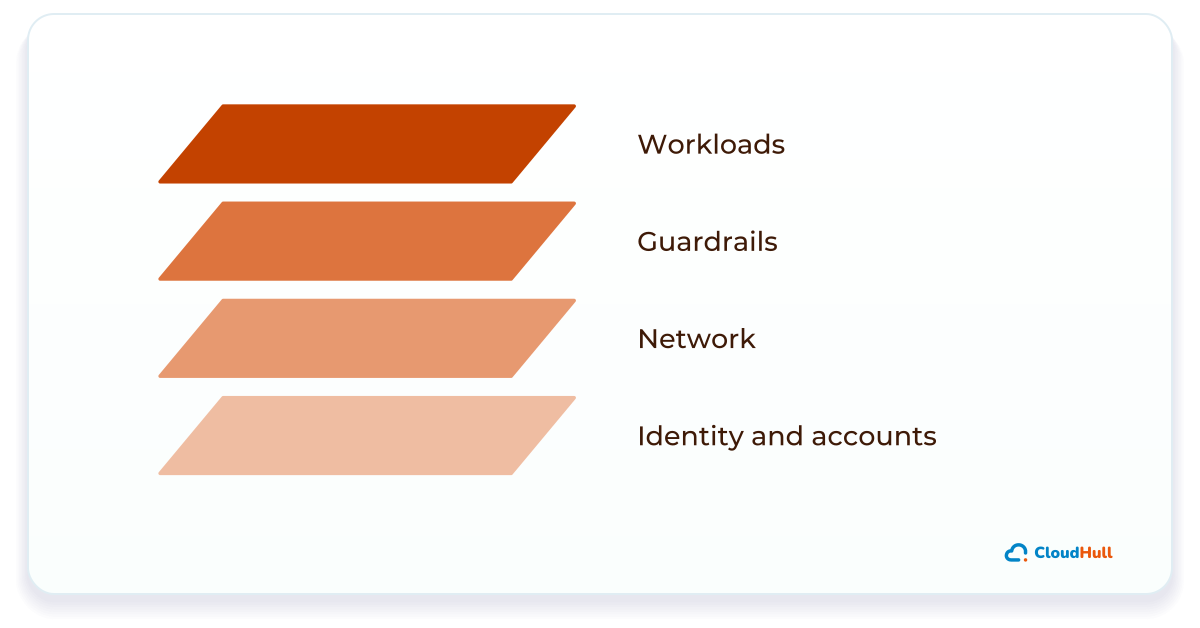
Test the foundation with a throwaway workload. If a developer cannot deploy it in a day, the guardrails are too heavy.
Phase 5: Migrate and Modernize in Waves
Group workloads into waves by dependency and risk. Run a low-risk first wave to practice the process, then increase scope. Each wave gets a cutover runbook, a rollback plan and a go or no-go review.
Avoid peak business periods. A move planned around a quarter close or a sales season is a move that gets postponed or rushed.
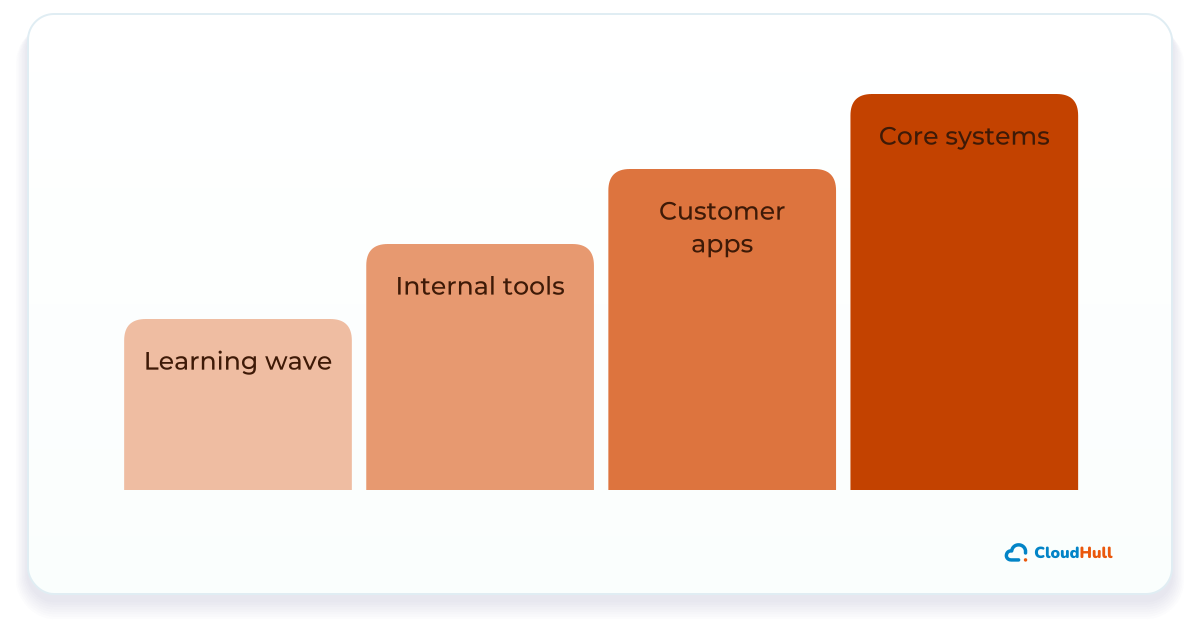
After every wave, hold a short review and update the runbooks. The third wave should take half the effort of the first.
The timing of each wave belongs on a calendar. The cloud strategy roadmap shows how to lay waves out against budget cycles and business peaks.
Phase 6: Operate and Optimize
Move from project mode to run mode. Review cost monthly with the budget owners, review security findings weekly and review the strategy itself every quarter. Rightsize, schedule off-hours shutdowns and use commitment discounts once the usage pattern is stable.
Track a small set of metrics: cost per workload, deploy frequency, recovery time, availability and open security findings.
Commitment discounts pay off after you know your steady usage, not before. Buying them during the first migration usually locks in capacity you do not need.
Gates You Should Not Skip
Each phase ends with a short gate review. It takes an hour and has one question: can you show proof? The cloud strategy checklist gives you 11 points that map to these gates, and the finished projects in my cloud strategy examples show what passing them looks like.
| Gate | Question to answer | Evidence |
|---|---|---|
| After phase 1 | Do you agree on the ranked outcomes? | Signed goal sheet |
| After phase 2 | Do you know what you run and what it costs? | Inventory and baseline |
| After phase 3 | Is every workload placed and the provider chosen? | Decision log, exit plan |
| After phase 4 | Can a team deploy safely on the foundation? | Test workload live |
| After each wave | Did the move meet cost, risk and schedule targets? | Wave review notes |
Keep gate meetings short and binary. The group either accepts the evidence or names what is missing and sets a date. I have watched gates turn into two-hour debates about design details that belonged in the phase itself. If a gate takes longer than an hour, the phase was not finished, and the right answer is to send the team back with a short list instead of arguing in the room. Record each decision in a single page so that people who join later can see why choices were made.
What a Placement Decision Log Looks Like
The decision log from phase 3 is the most useful single document in the framework. It is short, and it forces the argument to happen once instead of in every meeting. A useful entry has five fields: the workload, the chosen option, the reason, the risk and the owner.
| Workload | Decision | Reason | Risk |
|---|---|---|---|
| Customer web storefront | Replatform | Needs autoscaling for sales peaks, code changes are small | Session handling needs rework |
| Internal reporting tool | Rehost | Stable, low value of change, quick win for the first wave | Licensing on the database |
| Legacy order export | Retire | Replaced by a feature in the new platform | Two partners still use the file feed |
| Core ledger system | Retain | Regulatory review in progress, no business case to move yet | Data center contract renewal date |
Notice that two of the four rows do not move at all. That is normal. A decision log with only "refactor" in the second column is a wish list, and the person who signs it will pay for the optimism later.
Where Each Phase Usually Goes Wrong
Over many projects I see the same failures in the same places. Naming them in advance makes them easier to dodge.
| Phase | Typical failure | How to avoid it |
|---|---|---|
| 1. Align | Goals are vague or contradict each other | Rank outcomes and write a number next to each |
| 2. Discover | Inventory built from one source only | Cross-check against billing and network data |
| 3. Decide | Every workload gets the same treatment | Use a decision log with a written reason per row |
| 4. Build | Foundation designed in isolation for months | Time-box it and test with a real workload |
| 5. Migrate | First wave is too ambitious | Pick a low-risk workload that teaches the process |
| 6. Operate | Nobody owns the monthly cost review | Name an owner per product and put the review in the calendar |
The pattern across the table is ownership. Most failures are not technical. They happen because two people each thought the other was responsible, or because a gate was skipped to keep a date. When you hit a problem in any phase, check first who owns the decision and whether the previous gate was really passed.
How This Compares With Provider Frameworks
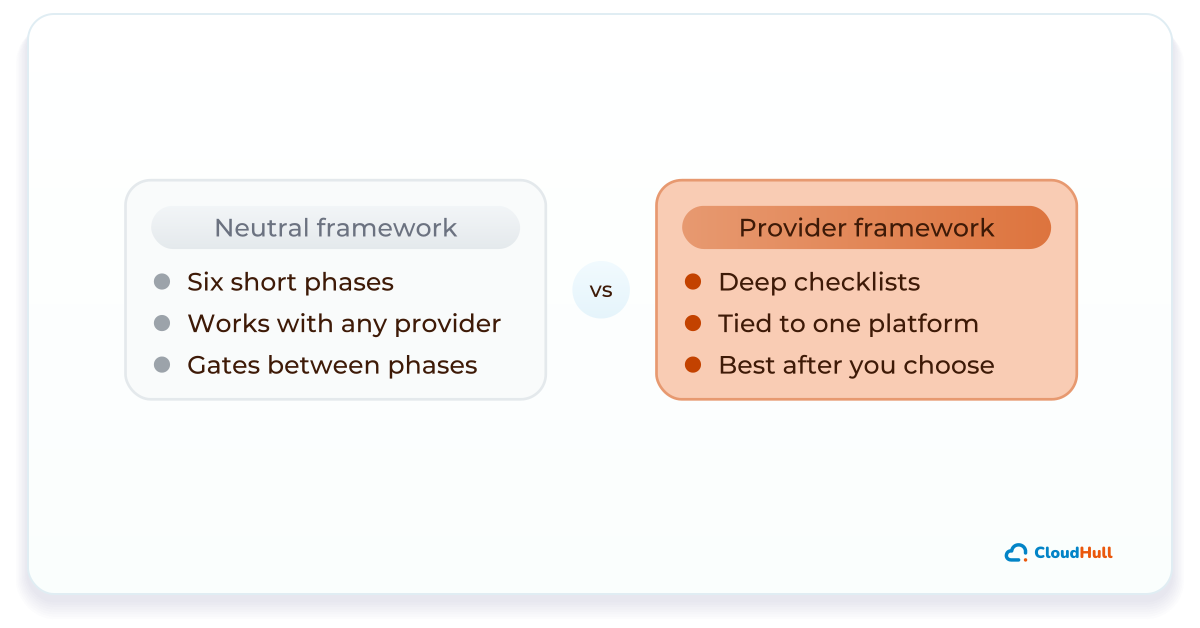
AWS, Microsoft and Google each publish an adoption framework, and they are worth reading. The AWS Cloud Adoption Framework, the Microsoft Cloud Adoption Framework for Azure and the Google Cloud Adoption Framework all cover strategy, readiness, migration and governance. They are thorough and tied to one provider's services.
My six phases are provider-neutral and shorter. I treat the provider frameworks as reference libraries: once you pick a provider in phase 3, borrow their checklists for the foundation and migration phases. For the cost discipline in phase 6, the FinOps Foundation framework is a good companion.
Adapting the Framework to Your Size
Small teams should merge phases 2 and 3 into one workshop and keep the gates informal. Mid-sized organizations can run the model as written. Large enterprises should run several instances in parallel, one per business unit, with a shared foundation phase and a central review. In every case keep the order. Teams that start phase 5 before phase 4 are the ones calling me six months later to fix an account structure.
Sources
- AWS Cloud Adoption Framework
- Microsoft Cloud Adoption Framework for Azure
- Google Cloud Adoption Framework
- FinOps Foundation framework
Questions About the Cloud Strategy Framework
What Is a Cloud Strategy Framework?
It is a structured model that takes you from business goals to a running cloud environment in defined phases, each with an output and a review gate. It keeps decisions in the right order, so that provider choice, security and cost are settled before workloads move.
How Is a Framework Different from a Roadmap?
The framework defines the phases, outputs and gates, and stays the same across projects. A roadmap applies it to your company with dates, budgets and owners. Use the framework first, then build the roadmap.
Which Provider Framework Should I Follow?
Follow the one that matches the provider you choose in phase 3. Before that, stay provider-neutral. If you run several providers, use a neutral model like this one for strategy and each provider's framework for the technical details.
How Long Does It Take to Run All Six Phases?
Phases 1 to 4 take roughly three to five months for a mid-sized organization. Migration and modernization then run for months or years, depending on how many workloads you move. Optimization never ends.
Can We Skip the Discovery Phase If We Already Know Our Estate?
Rarely. Most teams I work with find 10 to 20 percent more systems than their records list. A shortened discovery that checks the inventory against billing and network data is still worth a week.
Do Small Companies Need a Formal Framework?
They need the same questions in a lighter form. A three-page strategy covering outcomes, placement, provider, security baseline and cost owner is enough, and the gates can be a short meeting.
Who Should Approve Each Gate?
The sponsor approves gates 1 and 3, the technical lead approves gate 4 and the wave reviews, and finance co-signs the baseline in gate 2 and the cost results after each wave. Security signs off on the foundation.
Please note: this guide is general information and not legal, financial or tax advice. Numbers and examples are typical-project estimates; confirm current details with your providers and advisers.
Did this article help you?
Thanks, noted.
Garrett Linville
Garrett leads the Cloud Hull editorial team and works with the consultants to turn real client projects into practical guides on cloud migration, DevOps, security and cost control. Each article is edited together with the consultant who did the work, and every price and limit is checked against current provider documentation. He is based in the USA and works remotely.