Main Points
- Write three to five security goals that can be answered with yes or no.
- Measure a baseline first, so you fix risk instead of whatever is easy.
- Build controls in order: guardrails, then detection, then specialist tools.
- Review four numbers every quarter and change the plan when they do not move.
A cloud security strategy is a short written plan that says what you protect, who owns it, what you will do about it this year and how you will know it worked. Most teams skip it and go straight to buying tools. Six months later they have three dashboards, 4,000 open alerts and no clear owner. A cloud security consulting engagement usually starts with this plan for that reason.
The framework below has five phases. I have used it with fintech and ecommerce teams from 20 to 400 engineers, and it fits on a few pages. You can finish a first version in about three weeks if you keep the scope tight.
Overview of the Five Phases
| Phase | What it answers | Output | Typical time |
|---|---|---|---|
| 1. Goals | What must the cloud never do or lose? | Three to five security goals | 2 to 3 days |
| 2. Baseline | Where are we today? | Scored cloud security assessment | 1 to 2 weeks |
| 3. Priorities | What do we fix first? | Ranked list with owners | 2 to 3 days |
| 4. Controls | How do we prevent and detect problems? | Policies, guardrails and tooling choices | Ongoing, first release in 4 to 6 weeks |
| 5. Review | Is it working? | Quarterly scorecard | Half a day per quarter |
Phase 1: Write Goals You Could Fail
A good goal can be checked. "Be secure" cannot. "No customer data is reachable from the public internet" can. "A leaked access key is revoked within one hour" can. I ask clients for three to five goals, each tied to a business fear: a breach headline, a failed customer review, a fine, a week of downtime.
Start from the data you would hate to lose. For a payments company that is card and bank data. For an online shop it is customer accounts and order history. The goals follow from there, and every later decision can be tested against them.
Phase 2: Measure Where You Stand
You need a baseline before you pick controls, otherwise you end up fixing what is easy instead of what is risky. The baseline is a scored assessment across identity, data, network, logging, workloads and governance. Use one yardstick, for example the CIS Benchmark for your provider, and keep it for every later review. If you have never run one, my guide to the assessment walks through the scoring.
Do not wait for a perfect picture. A rough baseline in a week beats a thorough one in two months. The point is to find the gaps that clash with your goals from phase 1.
Phase 3: Pick the Work That Moves the Goals
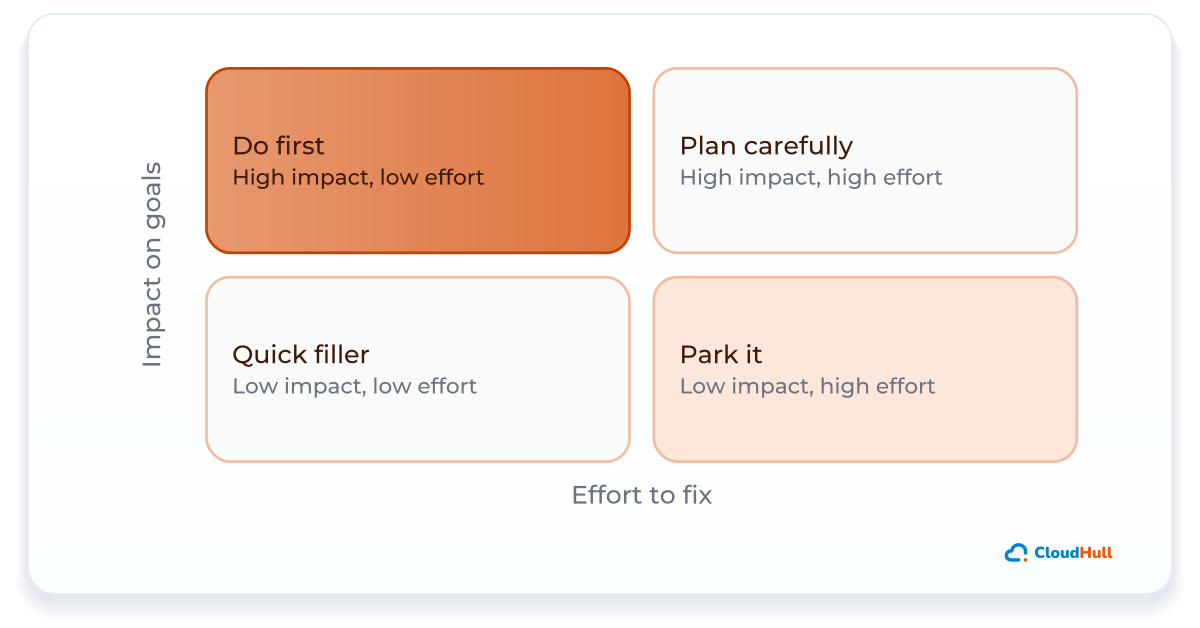
Take every gap from the baseline and ask which goal it threatens. Gaps that touch no goal wait. For the rest, rank by exposure and effort. A one-hour fix that removes public access to a storage bucket beats a six-month project that improves a low-risk system.
Limit the first year to what your team can really absorb. A team of three engineers who also run production can handle perhaps one security project per quarter. I have seen plans with 40 initiatives where 35 never started. Write the short list, name one owner per item and put a date on it.
Phase 4: Choose Controls in Three Layers
Controls come in three layers, and the order matters. Build the cheap, structural layer first, then detection, and only then add specialist tools.
| Layer | Examples | When to build it |
|---|---|---|
| Guardrails | Single sign-on, enforced MFA, account structure, policies that block public storage, encryption defaults | First 30 days |
| Detection | Central audit logs, alerts on risky changes, a named on-call person | Days 30 to 90 |
| Specialist tools | Posture management, workload protection, container scanning, secrets scanning | When guardrails and detection exist |
Teams often reverse this order and buy a posture platform first. The platform then reports thousands of issues that a guardrail would have prevented in the first place. If you do reach the tooling stage, compare options in my review of cloud security tools and match them to the gaps you measured, not to a vendor demo.
What a One-Page Strategy Looks Like in Practice
A mid-sized online retailer I worked with had one engineer who was part-time responsible for security. We wrote the whole strategy on a single page. The goals were three sentences: no customer data reachable from the internet, every admin action logged and reviewed, and every production change traceable to a person. The baseline scored them 9 out of 18. The top priorities were enforcing multi-factor authentication, turning on central logging and cleaning up two old accounts. Controls for the first quarter were exactly those three, and nothing else.
That narrow scope was the point. By the end of the quarter all three were done, the engineer had time to look at the alerts, and the next quarter's plan added detection rules and a container scanning tool. A plan with fewer items finished sooner and gave the team confidence.
Who Does What in a Small Team
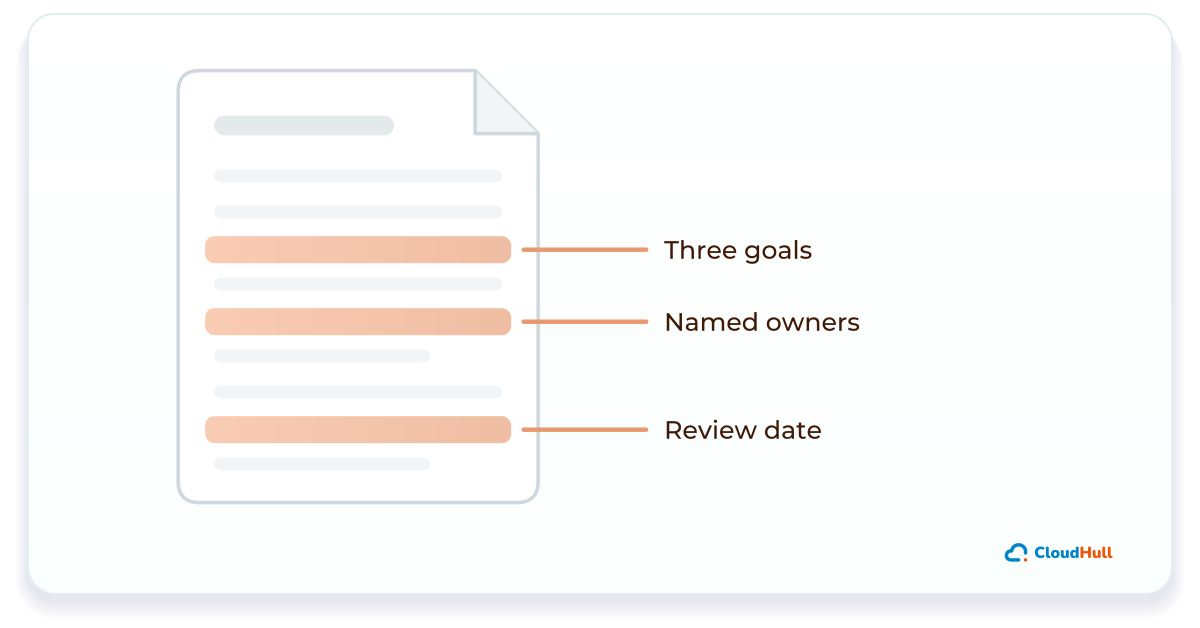
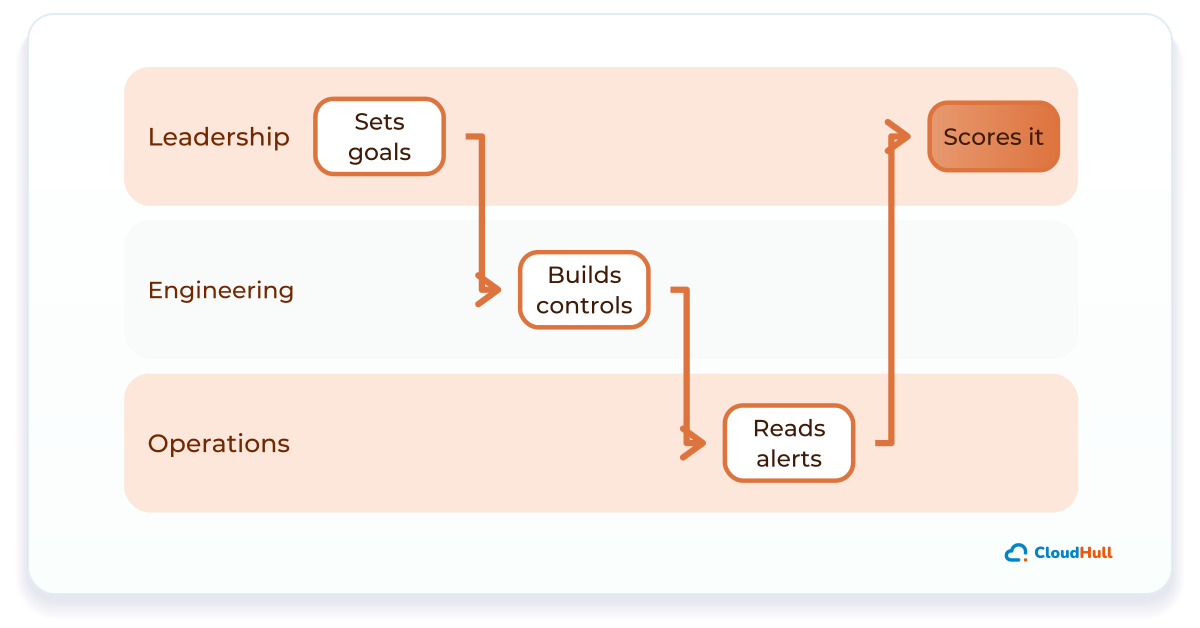
Even a small team needs clear roles, otherwise the plan sits in a folder. Name one owner for the strategy and one for each priority item. Give the owner the authority to say no to risky changes, and make sure the person who approves budget sees the scorecard. In companies under 50 engineers I usually combine roles: the head of engineering owns the strategy, a platform engineer owns guardrails and logging, and each product team owns the findings in its own accounts.
Agree on how exceptions work, too. Sooner or later a team will need a public bucket or a broad permission for a launch. Write down who can approve it, how long it lasts and when it gets reviewed. An exception with an expiry date is a decision. One without an expiry date is a hole.
Where Strategies Fail
Most plans fail in the same three places. They are too long, so the team never starts. They have no owner, so nobody notices when work slips. Or they were written for an auditor and not for the engineers who have to carry them out. If you spot any of these early, shrink the plan. A strategy that fits on a page and gets read beats a thirty-page document that does not. Pair it with a short working list such as the cloud security checklist so the principles reach day-to-day work.
Be Clear on Who Secures What
Cloud providers secure the underlying infrastructure. You secure what you put on it: identities, configuration, data and applications. AWS, Azure and Google Cloud all publish a shared responsibility model, and the exact split changes with the service type. Write it into your strategy for each service you use. The most common breach cause I see is a setting that both sides assumed the other one handled.
What It Costs and Who Pays
Budget in three buckets: people time, tools and outside help. For a company with one cloud and a small platform team, the first year is usually dominated by people time, since most guardrails use features you already pay for. Tools come second, and many have free tiers that cover a first pass. Outside help is the smallest line if you use it for the baseline and the review rather than for ongoing operations. Ask for fixed quotes and a clear list of deliverables.
Phase 5: Review Every Quarter With a Scorecard
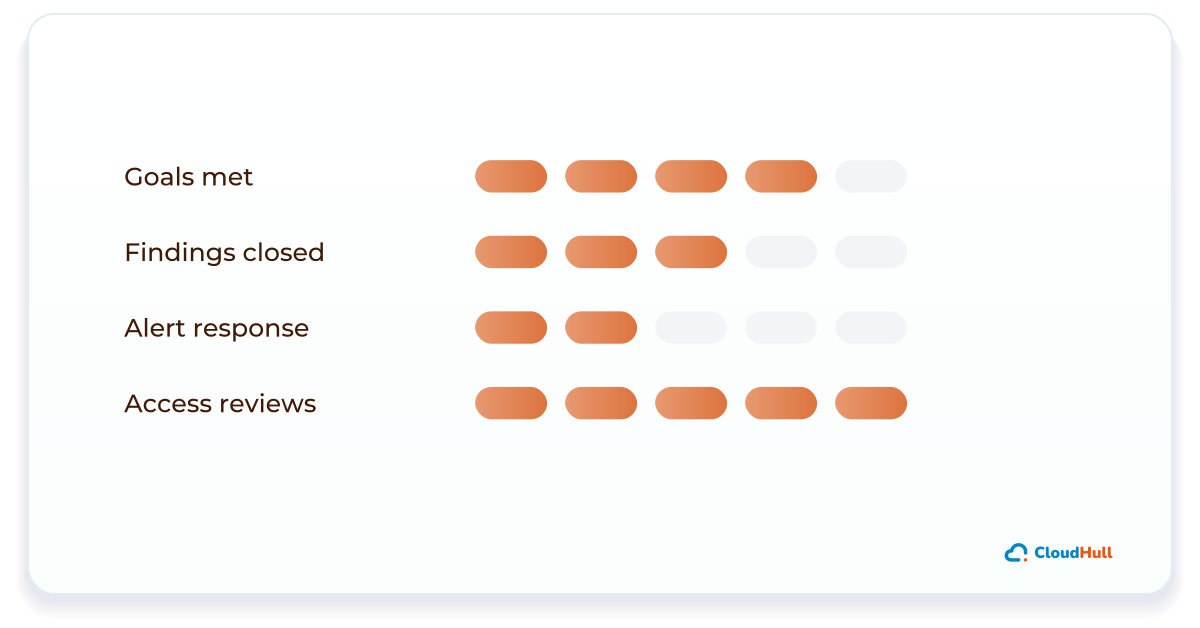
Keep the review short. Four numbers are enough: your assessment score by area, the number of critical findings open longer than 30 days, the time to revoke a leaked credential and the share of production accounts covered by central logging. Put the scorecard in front of whoever signs the budget. If the numbers do not move, change the plan, not the scorecard.
When the strategy is stable, the checks can be turned into a recurring cloud security audit and a checklist that engineers use at release time. Smaller teams can start with a trimmed version, which I describe in cloud security for small business.
Strategy Choices When You Use More Than One Cloud
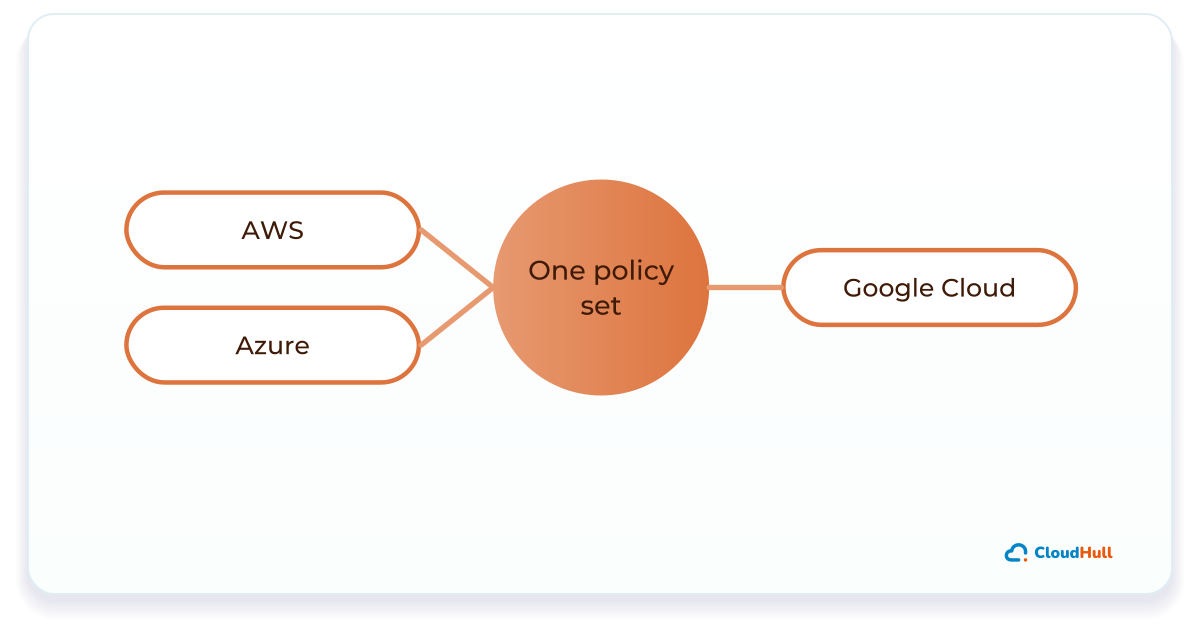
If you run workloads on two providers, write the strategy once and map it to each provider. The goals and priorities stay the same. Only the controls differ in name: a service control policy on AWS, an Azure Policy on Azure, an organization policy on Google Cloud. Keep a short table that lists each guardrail and the equivalent setting per provider, so engineers do not have to guess.
Avoid a separate security process per cloud. I have seen teams run two scorecards and two review meetings, and within a year one of them lapsed. One scorecard, one owner and one list of priorities is easier to keep alive.
How to Present the Plan to Your Leadership
Leaders rarely ask for technical detail. They want to know three things: what could hurt the business, what you will do about it and what it costs. Open with the goals in plain language, show the baseline as a single score with a trend, and close with the first-quarter list and the budget. Keep the appendix for the engineers.
How to Choose Your First Moves
If you only have time for three things this quarter, do these: enforce multi-factor authentication for every human with admin rights, turn on central audit logging in every account and remove public access to storage unless there is a written reason. They cost little, they remove the most common causes of cloud breaches in my client work and they give your strategy something to build on. Everything else can wait for the baseline to tell you what matters.
Sources
Questions About Building a Cloud Security Strategy
What Should a Cloud Security Strategy Include?
Goals tied to business risk, a scored baseline, a ranked list of work with owners, a choice of controls in three layers and a quarterly review. Keep it to a few pages so people actually read it.
How Long Does It Take to Write One?
A first version takes about three weeks when the scope is one cloud provider and one team. The baseline assessment takes the longest, and the rest is mostly decisions.
Who Should Own the Strategy?
One named person, usually the head of engineering, a security lead or the CTO in a small company. Execution is shared, but one owner has to answer for the scorecard.
Do I Need a Security Tool to Have a Strategy?
No. Guardrails and logging use features your cloud provider already offers. Add specialist tools only when you have measured a gap they would close.
How Is a Strategy Different from a Policy?
A strategy says what you will do and in which order. A policy is a rule that people follow day to day. The strategy produces a few policies, such as one on access reviews.
How Often Should I Update the Strategy?
Review the scorecard every quarter and rewrite the plan once a year, or after a big change such as a migration, an acquisition or a new compliance requirement.
What Is the Most Common Mistake?
Buying tools before measuring the baseline. It produces a flood of alerts with nobody assigned to act on them, and the same gaps stay open.
Please note: this guide is general information and not legal, financial or tax advice. Numbers and examples are typical-project estimates; confirm current details with your providers and advisers.
Did this article help you?
Thanks, noted.
Garrett Linville
Garrett leads the Cloud Hull editorial team and works with the consultants to turn real client projects into practical guides on cloud migration, DevOps, security and cost control. Each article is edited together with the consultant who did the work, and every price and limit is checked against current provider documentation. He is based in the USA and works remotely.