Main Points
- Score six dimensions from 1 to 4, and write down the evidence behind each score.
- Use delivery metrics such as lead time and change fail rate to check what interviews tell you.
- Fix the two weakest dimensions that slow delivery most, not everything at once.
- Repeat the same questions twice a year so your scores show a trend.
Most teams know something is off in their delivery process. Releases feel risky, a few people hold all the knowledge, or incidents repeat. What they lack is a way to say how bad it is and where to start. That is the job of a DevOps assessment, and it is the first step of any cloud DevOps consulting engagement I run.
Below is the framework I use with clients. It scores six dimensions, ties each score to evidence and ends with a plan short enough that your team will actually follow it.
What a DevOps Assessment Actually Measures
A DevOps assessment looks at the path your code takes from a developer's laptop to a running production system, and at what happens when that system misbehaves. It covers people and process as much as tools. A team with a modern CI platform and a manual approval chain of five people still ships slowly.
I split the review into six dimensions. Each one answers a plain question about your daily work.
| Dimension | What it answers | Evidence to collect |
|---|---|---|
| Source and branching | Can anyone see, review and trace every change? | Pull request history, branch rules, review times |
| Build and test | Does every commit get built and tested automatically? | CI run logs, test coverage reports, flaky test list |
| Release and deployment | How often and how safely does code reach production? | Deployment log, rollback history, approval steps |
| Infrastructure and environments | Can you rebuild an environment from code? | Infrastructure repository, drift reports, environment count |
| Monitoring and incidents | Do you find problems before customers do? | Alert list, on-call load, incident reviews |
| Security and culture | Is security part of the pipeline, and do people learn from failures? | Scan results, access reviews, blameless review notes |
Notice that none of the evidence column needs a survey. I would rather read three months of pipeline runs than ask ten people how they think releases go. Interviews still matter, but they explain the data and do not replace it.
A Four-Level Scale You Can Score in an Hour
Each dimension gets a score from 1 to 4. Keep the scale small. Five or ten levels invite long arguments about the difference between a 6 and a 7 that nobody can settle with evidence.
| Level | Name | How it shows up |
|---|---|---|
| 1 | Ad hoc | Work depends on individuals. Steps are manual and differ between people. |
| 2 | Repeatable | A written process exists and most people follow it, but gaps and manual handoffs remain. |
| 3 | Automated | The process runs through tooling, every change takes the same path and failures are visible. |
| 4 | Measured | The process is automated, tracked with metrics and improved on a schedule. |
Take build and test as an example. A team that runs tests by hand before a release is at level 1. A team with a CI job that most people watch, but where failing tests get skipped on deadline days, is at level 2. Every commit tested automatically with a blocked merge on failure earns a 3. Level 4 adds tracked flaky-test rates and a coverage trend the team reviews monthly.
Use Delivery Metrics to Check the Scores
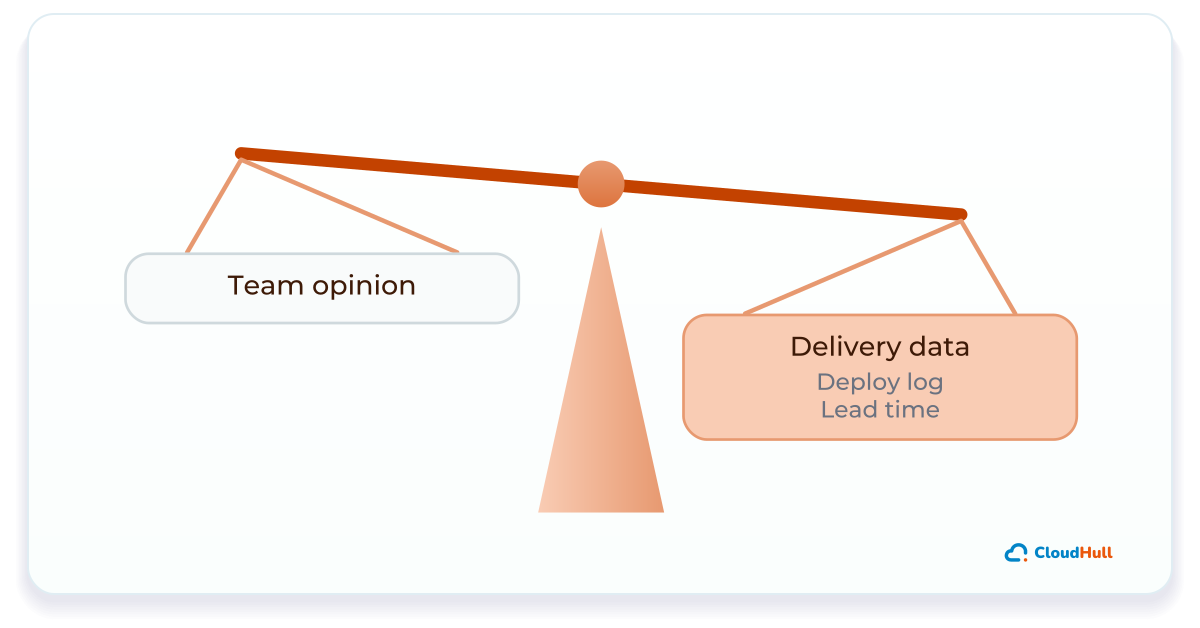
Scores from interviews carry opinion. Delivery metrics carry numbers. The DORA research program defines five software delivery metrics, and I use them as a cross-check on every assessment.
- Change lead time: the time from a commit to that change running in production.
- Deployment frequency: how many deployments happen over a period.
- Failed deployment recovery time: how long it takes to recover from a deployment that needs immediate intervention.
- Change fail rate: the share of deployments that need a rollback or hotfix.
- Deployment rework rate: the share of unplanned deployments caused by a production incident.
If a team scores itself a 3 on release and deployment but ships once a month with a lead time of three weeks, the metrics win. Something in the path is manual, queued or approved too slowly. Finding that step is the whole point of the exercise, and my guide to DevOps implementation steps shows how to remove it once you have found it.
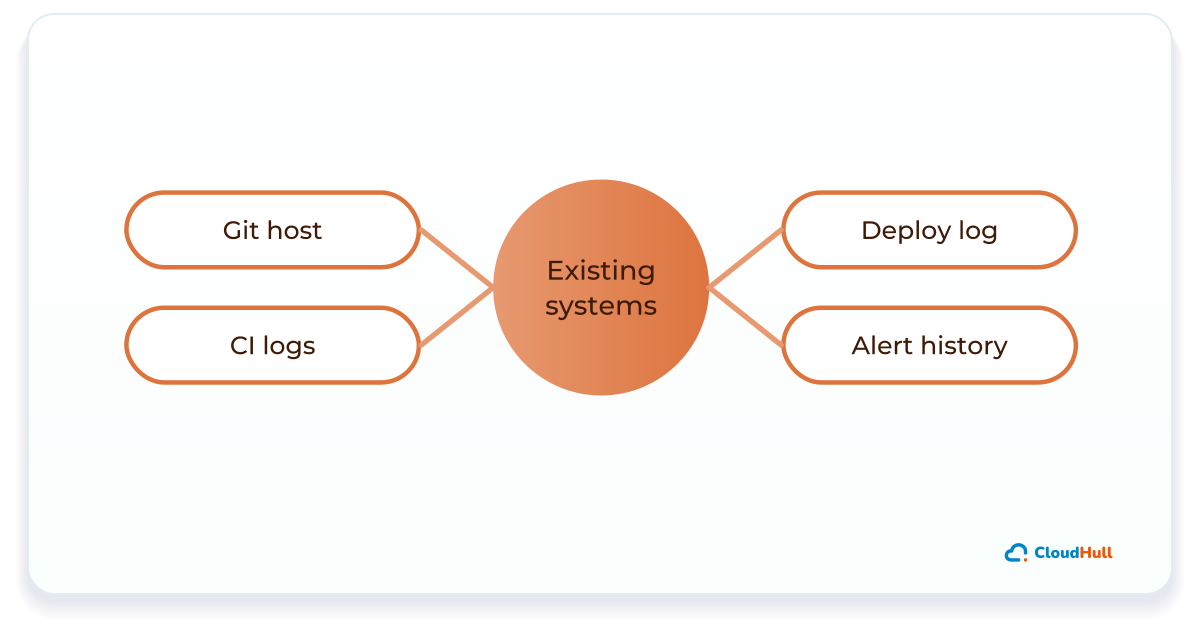
Pull the numbers from systems that already hold them. Your Git host has commit and merge times, your CI system has run times, and your deployment tool or release tags show when changes went live. An hour with a spreadsheet gives you a first baseline. Perfect data can wait for the second assessment.
A Worked Example From a Payments Team
Here is a condensed assessment from a payments team of 14 engineers, shared with the client's permission and with details changed. They believed their problem was tooling.
| Dimension | Score | Evidence behind the score |
|---|---|---|
| Source and branching | 3 | Mandatory reviews, protected main branch |
| Build and test | 2 | CI exists, but 9 integration tests failed at random and were routinely re-run |
| Release and deployment | 1 | Manual deploy script run by two people, release window on Thursdays |
| Infrastructure and environments | 2 | Production in code, staging built by hand and out of date |
| Monitoring and incidents | 2 | Alerts fired 60 times a week, about five were actionable |
| Security and culture | 2 | Dependency scans ran but nobody owned the results |
The team assumed they needed a new CI platform. The scores said otherwise. The weakest dimension was release and deployment, and the cause was a manual script owned by two people. The flaky tests and noisy alerts made it worse, because nobody trusted a green build or a quiet pager.
The plan had two goals for the first quarter: automate the deployment script into a pipeline step with an automatic rollback, and cut the weekly alert count to under 20 by deleting or tuning the rest. Lead time fell from roughly three weeks to about five days in the following months. I would not promise those numbers to anyone else, since they depended on a team that was ready to change the Thursday window.
How to Run the Assessment in One Week
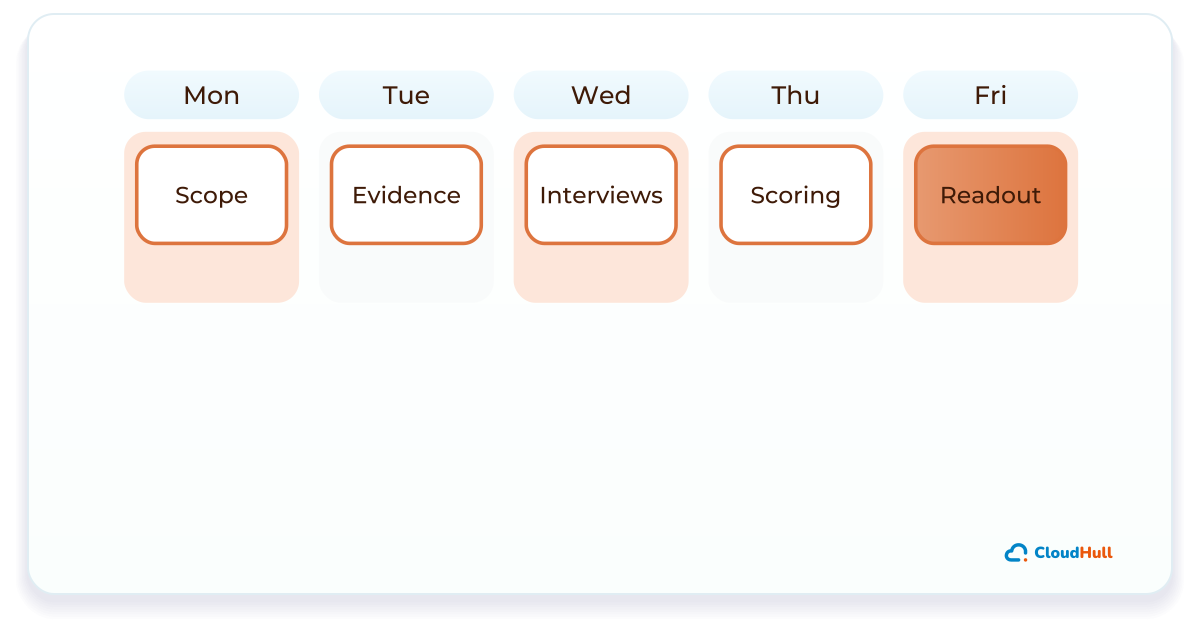
A single product team needs about five working days. Larger organizations repeat the same week per team, because a company-wide average hides the teams that need help most.
- Day 1, scope and access. Pick the product, name the people to interview and get read access to the Git host, CI system, deployment tool and monitoring.
- Day 2, interviews. Talk to an engineer, the person who is on call and whoever approves releases. Ask them to walk through the last release and the last incident step by step.
- Day 3, evidence. Read pipeline runs, merge times and alert history. Calculate the delivery metrics for the past three months.
- Day 4, scoring. Score each dimension with a second person. Disagreements are useful, since they show where the team sees things differently.
- Day 5, plan. Write a one-page summary with scores, the two priorities and one measurable goal each.
Two dimensions often need specialist eyes. Pipeline and environment code is easier to judge with someone who has seen many setups, and the tooling choices that follow are easier with a neutral comparison, which is what my ranking of DevOps tools provides. For the habits that sit behind a level 3 or 4 score, read my notes on DevOps best practices.
Turning Scores Into Priorities
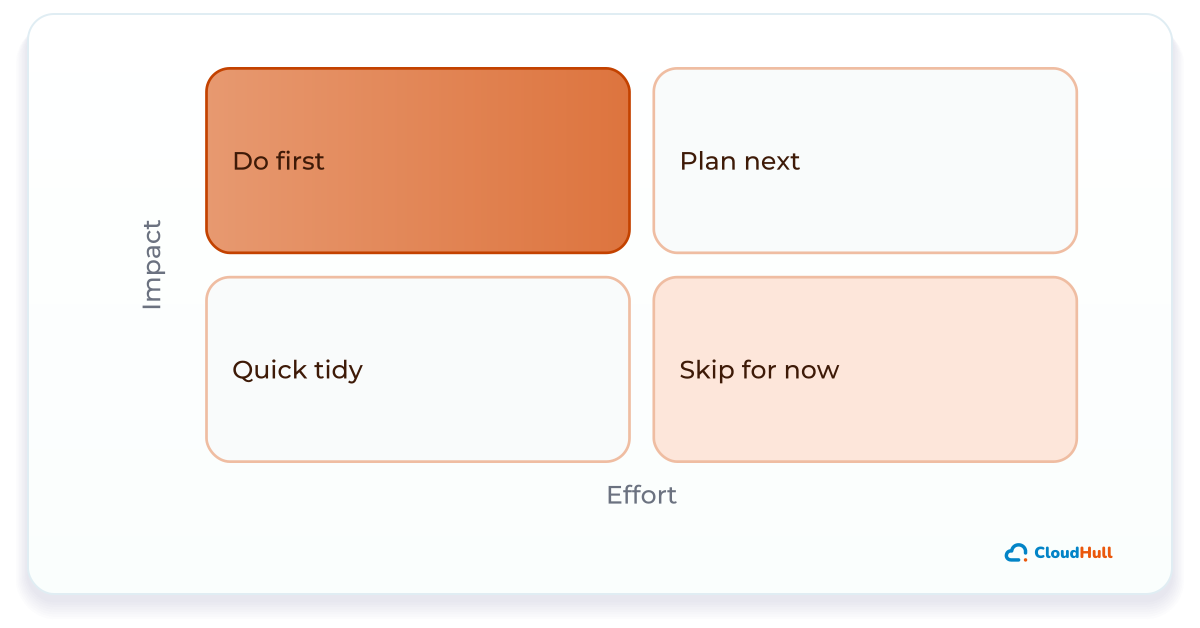
A list of six scores is not a plan. I turn it into one with three questions per dimension.
- Does this dimension slow delivery or add risk today, or does it just look untidy?
- Would one change lift the score by a level within a quarter?
- Does another dimension depend on this one?
In the payments example, release and deployment passed all three tests, so it went first. Build and test came second because flaky tests would have undermined the new pipeline. Security scores stayed on the list but not in the first quarter, since the team had no capacity and no urgent audit.
Most teams carry the same recurring problems, such as slow approvals, flaky tests and unclear ownership. My article on common DevOps challenges pairs each of them with a fix, which helps when you turn a low score into a task. If your lowest score sits in the pipeline, the biggest hours saved usually come from cloud DevOps automation.
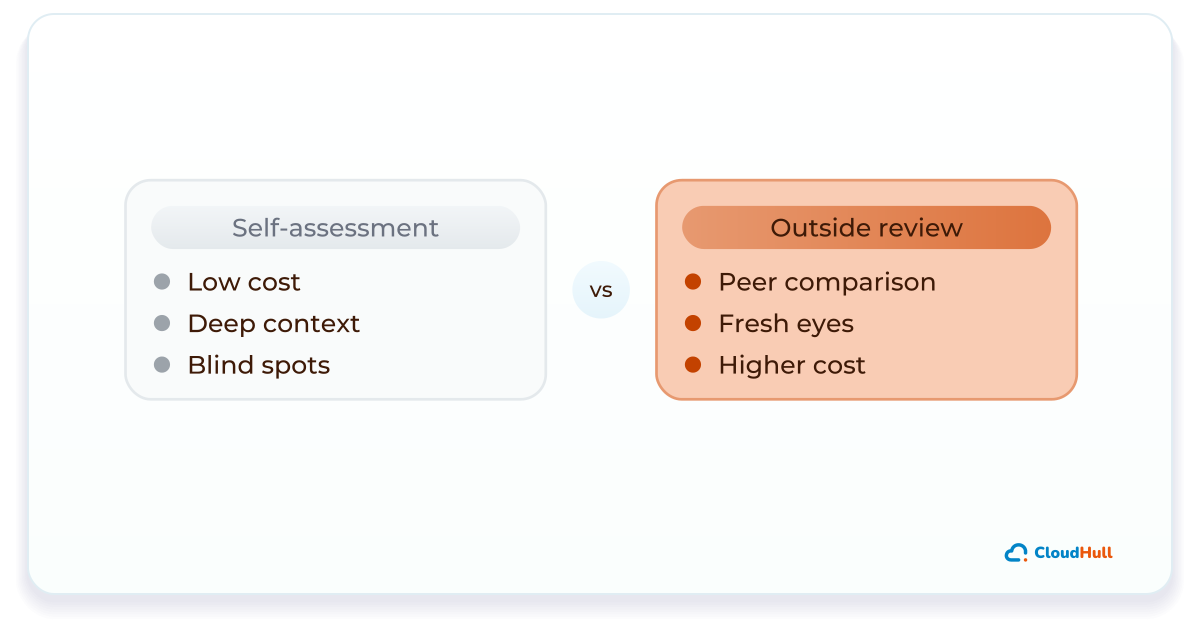
How to Choose Between a Self-Assessment and an Outside Review
A self-assessment costs only your team's time and works well when you have a platform engineer who has seen other organizations. It struggles when everyone shares the same blind spots, or when politics make low scores awkward to write down.
An outside review adds comparison. A reviewer who has seen dozens of pipelines spots the manual step that your team stopped noticing years ago. It also gives leadership a neutral document. If you go that route, ask the reviewer to show the evidence behind every score and to leave the assessment template with you, so the next round can be yours.
- The scoring scale and the questions are written down and reusable.
- Every score links to evidence you can open.
- The output is a short plan with owners, not a long report.
- Delivery metrics are part of the baseline.
Questions About DevOps Assessments
What Is a DevOps Assessment?
It is a structured review of how your team builds, tests, releases and runs software. You score practices such as version control, testing, deployment and monitoring, plus delivery metrics like lead time and change fail rate. The result is a ranked list of gaps, so you know what to fix first.
How Long Does a DevOps Assessment Take?
For one product team, I plan about a week: two days of interviews, two days of pipeline and repository review, and one day to score and write up. Several teams or a regulated environment take longer. The work is mostly reading real pipelines and incident history, not running workshops.
Which Metrics Should I Measure First?
Start with the DORA metrics: change lead time, deployment frequency, failed deployment recovery time and change fail rate. DORA also lists a fifth, deployment rework rate. You can pull most of them from your Git host and CI system without new tooling.
Can I Run a DevOps Assessment Myself?
Yes. A self-assessment works if you score from evidence, such as pipeline logs and ticket history, and not from opinion. The risk is grading yourself generously. Ask someone from another team to challenge every score above 3.
How Often Should I Repeat It?
Twice a year is a sensible rhythm for most teams. Repeat it sooner after a major change such as a cloud migration, a new platform team or a long outage. Keep the questions identical so scores compare over time.
What Is a Good DevOps Maturity Score?
There is no universal pass mark. A team shipping a regulated payments product may reasonably sit at level 3 on release speed and level 4 on security. Judge the score against what your business needs, and watch the trend between assessments.
What Should I Do with the Results?
Pick the two lowest-scoring dimensions that hurt delivery most and set one measurable goal for each, for example cutting lead time by a third. Fixing everything at once is how assessments end up in a drawer.
Sources
Please note: this guide is general information and not legal, financial or tax advice. Numbers and examples are typical-project estimates; confirm current details with your providers and advisers.
Did this article help you?
Thanks, noted.
Garrett Linville
Garrett leads the Cloud Hull editorial team and works with the consultants to turn real client projects into practical guides on cloud migration, DevOps, security and cost control. Each article is edited together with the consultant who did the work, and every price and limit is checked against current provider documentation. He is based in the USA and works remotely.